AC-Coupled vs. DC-Coupled Batteries: Which is Best for Your Solar?
Compare AC-coupled vs. DC-coupled home batteries. Learn about conversion steps, round-trip efficiency, retrofit ease, and system resiliency.
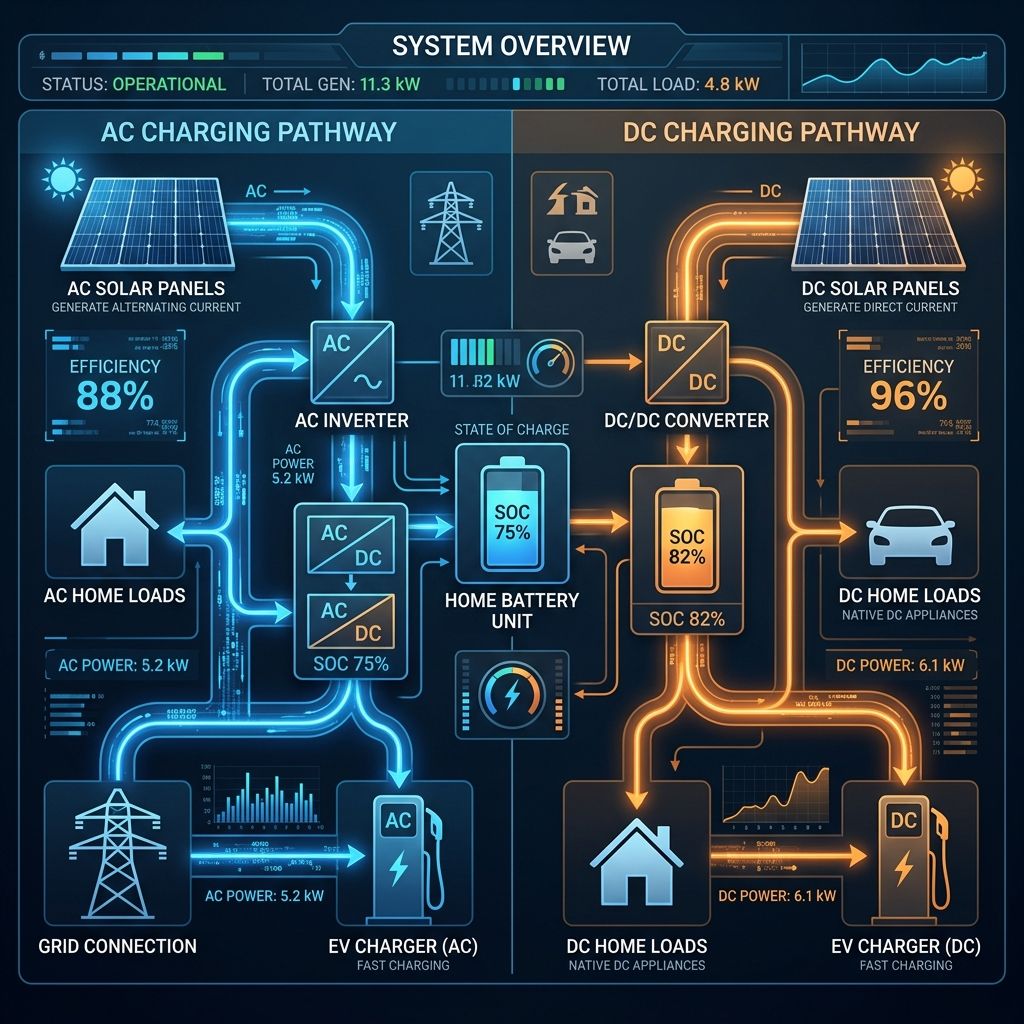
When designing a home solar-plus-storage system, one of the most critical decisions you will make is how the battery connects to your solar panels. In the energy storage industry, this architectural layout is divided into two formats: AC-coupled and DC-coupled systems.
While both systems accomplish the same goal—storing solar energy to power your home during blackouts or expensive utility peak hours—they route electricity in fundamentally different ways. Choosing the wrong coupling configuration for your home can lead to unnecessary conversion losses or inflated installation bills. Here is our head-to-head comparison of AC-coupled vs. DC-coupled batteries.
What is a DC-Coupled Battery System?
In a DC-coupled system, both your solar panels and your battery bank connect to the same central hybrid inverter. The electricity generated by your solar panels is in Direct Current (DC) format. Because batteries also store electricity in DC format, the solar power flows directly into the battery with zero conversion steps.
The power is only converted from DC to Alternating Current (AC) once: when it is discharged from the battery to run your household appliances. The leading example of a modern, DC-coupled system is the Tesla Powerwall 3, which houses a powerful hybrid solar-plus-storage inverter directly inside the unit.
What is an AC-Coupled Battery System?
In an AC-coupled system, your solar panels and your battery bank have separate, independent inverters. The solar panels have their own inverter (usually microinverters on the roof) that converts DC solar energy to AC power to run your home.
To charge the battery, that AC power must flow down to the battery's dedicated inverter, which converts it back into DC format. When your home calls for power later, the battery inverter converts it a third time back into AC format. Leading AC-coupled residential batteries include the Enphase IQ Battery 5P and the FranklinWH aPower.
Key Comparison Criteria Head-to-Head
To choose the correct coupling style, evaluate how they compare across three critical criteria:
1. Round-Trip Efficiency and Conversion Losses
Every time electricity is converted from DC to AC (or vice versa), a small percentage of energy is lost as heat. Standard inverters operate at roughly 95% to 97% efficiency:
DC-Coupled: Because energy goes from the panels directly to the battery in DC format, it experiences only a single conversion step when discharged. This results in high round-trip efficiencies of 90% to 94%.
AC-Coupled: Because energy must undergo three separate conversions (DC panels -> AC home -> DC battery -> AC home), it loses more power as heat, resulting in lower round-trip efficiencies of 85% to 89%.
Conversion Steps Explained
DC-coupled systems utilize a single hybrid inverter, resulting in fewer conversions and higher efficiencies (90%+). AC-coupled systems require three separate conversions, wasting 2% to 4% more energy as heat at each step.
2. Retrofitting vs. New Installations
DC-Coupled: If you have an existing solar system, retrofitting a DC-coupled battery is complex. It usually requires removing your existing solar inverter and replacing it with an expensive hybrid inverter, inflating labor costs.
AC-Coupled: If you already have solar panels installed, AC-coupling is the logical choice. The battery connects directly to your home's main AC breaker panel. It doesn't care what brand of solar panels or inverter you have, making installation quick and inexpensive.
3. System Resiliency and Fail-Safes
DC-Coupled: Because both panels and storage rely on a single hybrid inverter, that inverter represents a single point of failure. If the hybrid inverter breaks down, you lose both solar production and battery backup capability simultaneously.
AC-Coupled: Because the solar array runs on distributed microinverters and the battery has its own independent inverters, the system is highly resilient. If one microinverter fails, the rest of the solar panels and the battery backup will continue to operate normally.
AC-Coupled vs. DC-Coupled Comparison Grid
The table below summarizes the key trade-offs between AC and DC battery coupling architectures:
AC-Coupled vs. DC-Coupled Battery Comparison
| Round-Trip Efficiency (Energy retained) | DC-Coupled: 90% - 94% | AC-Coupled: 85% - 89% |
| Retrofit Ease (Adding to existing solar) | DC-Coupled: Complex & Costly | AC-Coupled: Simple & Quick |
| Inverter Resiliency (Points of failure) | DC-Coupled: Single Hybrid Inverter | AC-Coupled: Distributed Inverters |
| Compatibility (Working with other brands) | DC-Coupled: Highly Brand-Dependent | AC-Coupled: Works with any system |
Conclusion & Sizing Recommendations
The choice between AC and DC coupling comes down to whether you have an existing solar system. If you are installing a brand-new solar-plus-storage system from scratch, a DC-coupled system (like the Tesla Powerwall 3) offers the highest efficiency and lowest equipment footprint. However, if you are retrofitting storage onto an existing solar array, an AC-coupled battery (like the Enphase 5P or FranklinWH) is the superior choice, avoiding expensive inverter swap-outs. To evaluate the payback periods and local incentives for these configurations, use our interactive ROI calculator tool below:
Evidence
Sources and methodology
Article FAQ
Common questions
Can I convert an AC-coupled solar system to a DC-coupled battery later?
Yes, but it is rarely cost-effective. It requires rewiring your solar panels on the roof, replacing your existing solar inverter with a new hybrid inverter, and rewriting your electrical panel permits, which can add $3,000 to $5,000 in unnecessary labor costs.
Which coupling is better if I don't have solar panels?
If you don't have solar, the battery only charges directly from the grid (to save money during cheap hours or provide backup). In this case, an AC-coupled battery is the logical choice because it connects directly to your home's main AC breaker panel with no solar configuration needed.
Does the Tesla Powerwall 3 support AC-coupling?
The Powerwall 3 is primarily engineered as a DC-coupled hybrid battery with its own integrated solar inverter. However, Tesla allows it to be installed in AC-coupled configurations for retrofits by bypassing the solar inputs, though you may experience slight conversion losses compared to a native DC setup.

Written by
Battery Planning Editorial Team
The official editorial and research team for Battery Planning, providing expert battery sizing guides, specifications audits, and cost estimation planners.