Do I Need a Soft Starter to Run My AC on Battery Backup?
Learn how soft starters reduce AC starting surge (LRA) by 60% to 70%, allowing standard home batteries to back up central cooling systems without tripping.
As home battery backup systems become standard energy security solutions, many homeowners assume that a brand-new battery bank can easily run their entire home—including central air conditioning. However, the first time the grid goes down and the AC unit tries to start up, they are often met with a loud buzz followed by a complete battery shutdown.
The culprit is not a lack of battery capacity, but rather the massive, instantaneous electrical current required to start a standard air conditioning compressor motor. To solve this startup problem, solar installers frequently recommend adding a small accessory called a soft starter. But do you actually need one, and how does it work?
In short: Yes, if you plan to run a standard, single-stage or two-stage central air conditioner on a typical home battery backup system, you almost certainly need a soft starter. Without it, the initial starting current will exceed your battery's maximum surge output, causing the inverter's safety breakers to trip instantly. This guide breaks down the physics, calculations, and benefits to help you evaluate your system needs.
Understanding AC Surge Current: LRA vs. RLA
To understand why a battery struggles to start an air conditioner, you must review the electrical label on your outdoor AC condenser unit. On that metal sticker, you will find two key metrics:
RLA (Running Load Amps): This is the current the compressor draws continuously while cooling your home. A typical 3-ton AC unit might have an RLA of 12 to 15 Amps. At 240 Volts, this translates to roughly 2,800 to 3,600 Watts (2.8 to 3.6 kW)—a load that a standard 5 kW home battery can comfortably handle.
LRA (Locked Rotor Amps): This is the massive surge current the compressor draws for a fraction of a second when the motor first transitions from a complete stop to full speed. For that same 3-ton AC unit, the LRA rating is typically between 70 and 90 Amps. At 240 Volts, this represents a peak startup surge of 16,800 to 21,600 Watts (16.8 to 21.6 kW)—far exceeding the maximum surge limit of most residential battery inverters.
Check Your AC Condenser Label
Go outside and look at the metal specification sticker on your AC condenser unit. Look for the 'LRA' value. If it is over 50A, your home battery will struggle to start it without a soft starter accessory.
What is a Soft Starter and How Does it Work?
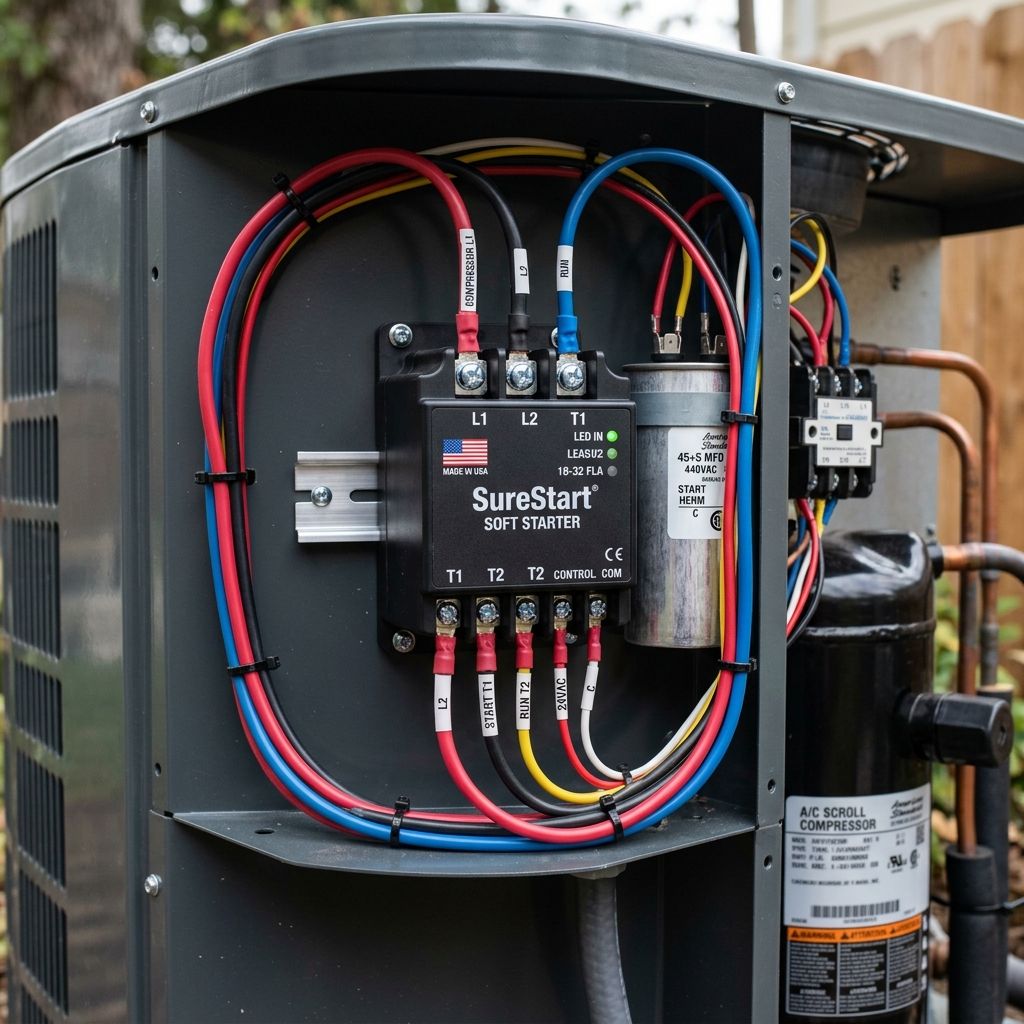
A soft starter is a compact electronic device that is wired directly into your outdoor AC condenser box, inline with the compressor's starter winding. It replaces the traditional start capacitor setup.
Instead of throwing the full utility voltage at the motor instantly (which causes the massive current spike), the soft starter utilizes solid-state switches to gradually ramp up the voltage over a period of 100 to 300 milliseconds. This smooth ramp-up allows the compressor motor to accelerate gently, reducing the starting current (LRA) by 60% to 70%.
For example, a soft starter can reduce an LRA spike of 80 Amps down to just 25 to 30 Amps. This brings the peak startup surge down to roughly 6,000 Watts (6.0 kW), which is well within the surge capacity limits of standard home battery backups.
When Do You Absolutely Need a Soft Starter?
Whether you need a soft starter depends on your AC unit's size and your battery's surge specifications. A standard home battery inverter (like the Enphase 5P or FranklinWH) has a continuous output limit of 3.8 to 5.0 kW, and a short-duration surge rating of 7.0 to 10.0 kW.
If your AC's LRA rating at 240V exceeds your battery's peak surge rating, the inverter will detect an overcurrent condition and instantly shut off to protect its electronics.
AC Unit Sizing & Battery Compatibility Matrix
LRA Startup Current With and Without Soft Starters
| 2-Ton AC Unit (LRA: ~60A vs. Soft Start LRA: ~20A) | Sufficient for 1 battery unit with Soft Start (Trips without) |
| 3-Ton AC Unit (LRA: ~78A vs. Soft Start LRA: ~26A) | Sufficient for 1 battery unit with Soft Start (Trips without) |
| 4-Ton AC Unit (LRA: ~110A vs. Soft Start LRA: ~35A) | Requires 2 stacked battery units + Soft Start (Trips without) |
Top Benefits of Installing a Soft Starter
Beyond enabling emergency cooling during a blackout, adding a soft starter offers three key advantages:
Prevents Battery Overload Trips: It ensures your backup power system continues to run smoothly without shutting down the entire critical loads panel when the thermostat calls for cooling.
Reduces Stress on Compressor Motor: Ramping voltage gradually prevents the sudden mechanical jerk and thermal heat spikes associated with high LRA starts, extending the lifespan of your expensive AC compressor.
Saves Money by Sizing Down the Battery: Without a soft starter, you would be forced to install two or three home batteries in parallel simply to handle the starting spike of a single AC unit. A soft starter allows you to run your AC on a single battery, saving you thousands of dollars in hardware costs.
Installation, Cost, and Compatibility
A quality soft starter (such as the Micro-Air EasyStart or Hyper SureStart) costs between $200 and $300 in equipment. Having a certified HVAC technician or electrician install it typically adds $150 to $200 in labor, bringing the total turnkey cost to $350 to $500.
Compatibility Note: Soft starters are designed for standard single-stage and two-stage compressors. If your home is equipped with a modern variable-speed inverter-driven air conditioner or ductless mini-split system, you do NOT need a soft starter. Variable-speed compressors naturally start at a very low capacity and ramp up gradually, drawing almost zero starting surge.
Conclusion & Sizing Recommendations
If backing up your cooling system is a priority for storm season, adding a soft starter is one of the most cost-effective investments you can make. It protects your equipment, keeps your home comfortable, and allows your home battery to operate within its design limits. To calculate how much continuous power your home consumes with AC running, use our interactive battery sizer calculator below:
Evidence
Sources and methodology
Article FAQ
Common questions
Does a soft starter reduce my monthly electric bill?
No. A soft starter only reduces the instantaneous surge current (LRA) during the first 300 milliseconds of starting. It does not alter the running load (RLA) or the total kilowatt-hours your AC consumes while cooling.
Can I install an AC soft starter myself?
It is not recommended. Installing a soft starter requires wiring into the compressor box, identifying start/run/common terminals, and handling the high-voltage dual run capacitor which stores a lethal charge. Hiring a licensed HVAC technician is safest.
Does a variable-speed heat pump need a soft starter?
No. Variable-speed heat pumps and inverter-driven mini-splits naturally utilize internal electronics to start the compressor at a very low frequency, bypassing the LRA spike entirely. They do not benefit from a soft starter.
Written by
Battery Planning Editorial Team
The official editorial and research team for Battery Planning, providing expert battery sizing guides, specifications audits, and cost estimation planners.