FranklinWH aPower vs. Enphase IQ Battery 5P: Head-to-Head Comparison
Compare FranklinWH aPower vs. Enphase IQ Battery 5P. Learn about usable capacities, continuous outputs, standby generator ports, and warranty terms.
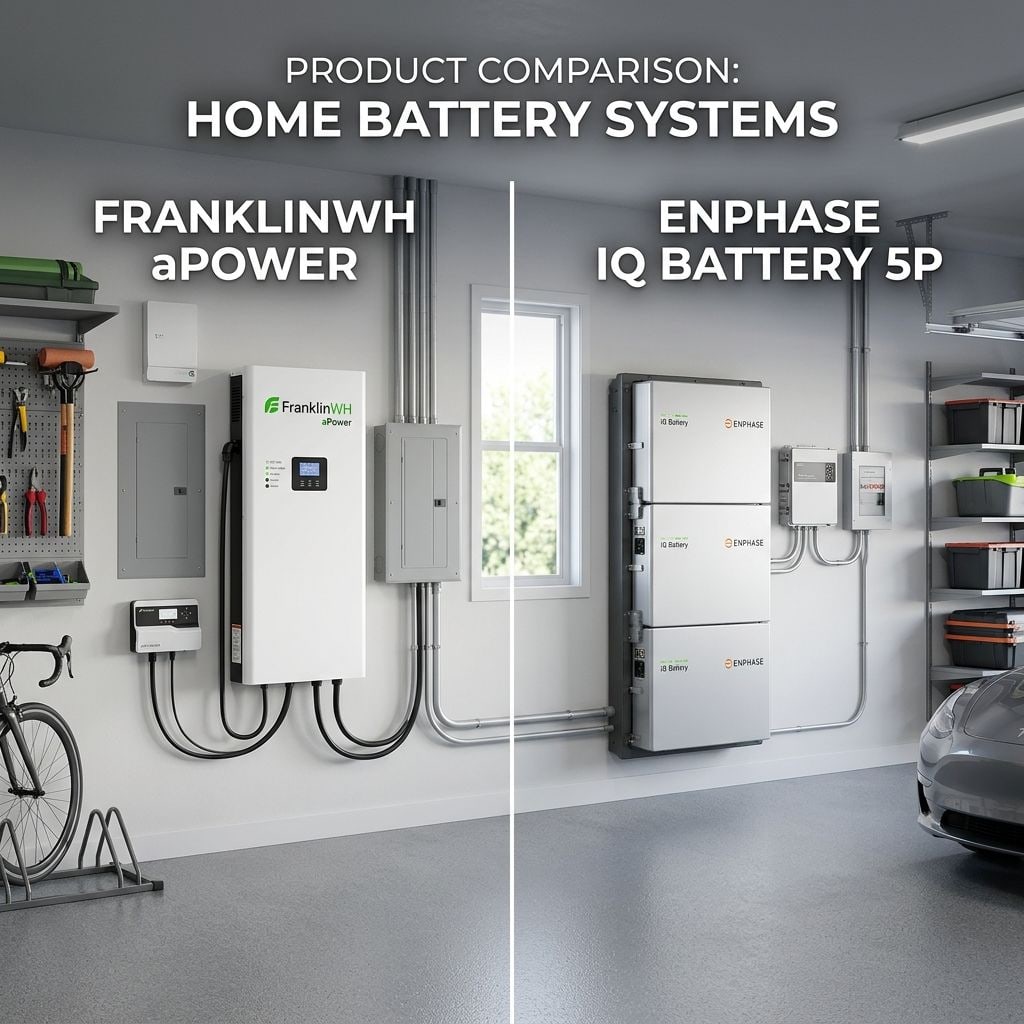
For homeowners with standby generators or those requiring native smart load management without buying a separate smart panel, the FranklinWH aPower system is superior. However, for those who prefer modular 5 kWh increments, want a unified Enphase app ecosystem, or prioritize an industry-leading 15-year warranty, the Enphase IQ Battery 5P represents the superior long-term investment.
Decision support
Comparison breakdown
| Criterion | FranklinWH aPower | Enphase IQ Battery 5P | Best fit |
|---|---|---|---|
| Usable Capacity | 13.6 kWh | 5.0 kWh (Modular) | FranklinWH aPowerFranklinWH offers 2.7x more capacity in a single unit. |
| Continuous Power | 5.0 kW | 3.84 kW | FranklinWH aPowerFranklinWH offers higher continuous discharge per battery pack. |
| Generator Support | Native (aGate port) | Requires load controllers | FranklinWH aPowerFranklinWH provides superior native standby generator integration. |
| Smart Load Shedding | Yes (Built-in aGate) | Requires load controllers | FranklinWH aPowerFranklinWH natively controls heavy appliances out of the box. |
| Warranty Length | 10 Years | 15 Years | Enphase IQ Battery 5PEnphase offers an exceptional 15-year warranty on the IQ 5P. |
| Chemistry | LFP (Cobalt-free) | LFP (Cobalt-free) | tieBoth use ultra-safe, long-lasting Lithium Iron Phosphate chemistry. |
When evaluating home battery systems, choosing an AC-coupled storage architecture is often preferred for retrofitting storage onto existing solar panels. The two leading AC-coupled options on the market are the Enphase IQ Battery 5P and the FranklinWH aPower system.
Both manufacturers utilize ultra-safe Lithium Iron Phosphate (LFP) cells, but their system layouts and software capabilities target different homeowner needs. Enphase focus on distributed microinverter redundancy, modular scaling, and integration with the Enphase app. FranklinWH focuses on standby generator integration and smart circuit controls. Here is our head-to-head comparison of FranklinWH aPower vs. Enphase IQ Battery 5P.
Inverter Architecture: Distributed Microinverters vs. Integrated Gateways
How these systems manage electrical conversion dictates their redundancy and controls:
Enphase IQ Battery 5P: Houses six separate IQ8D-BAT microinverters inside each 5 kWh battery enclosure. This distributed layout eliminates single points of failure. If one microinverter fails, the battery continues to operate at reduced capacity rather than shutting down completely.
FranklinWH aPower: Connects standard battery packs to the centralized aGate smart power controller. The aGate manages utility grid disconnects, standby generator connections, and smart sub-panel circuits inside a single gateway panel.
Head-to-Head Comparison Criteria
1. Usable Storage Capacity and Sizing Slices
Modular sizing flexibility determines how precisely you can match storage to your budget:
Enphase IQ Battery 5P: Scaled in modular 5.0 kWh units. Homeowners can install 1, 2, or 3 units to match their exact backup needs (e.g. 5, 10, or 15 kWh), adjusting capacity in precise increments.
FranklinWH aPower: Sized in large 13.6 kWh blocks. While FranklinWH offers excellent whole-home capacities, it lacks modular flexibility for smaller homes needing only basic essential load backup.
2. Continuous and Peak Power Output
Continuous output dictates what appliances you can run simultaneously during a blackout:
Enphase IQ Battery 5P: A single 5P unit delivers 3.84 kW of continuous output, but features a high peak surge output of 7.68 kW for 3 seconds. Multiple units must be installed in parallel to start heavy appliances safely.
FranklinWH aPower: A single aPower unit delivers 5.0 kW of continuous output, and features a high transient peak surge rating of 10.0 kW for 10 seconds. Stacking multiple aPower units increases continuous output.
3. Standby Generator Integration
Standby generators provide critical support during extended outages:
FranklinWH: The aGate contains a native, pre-wired generator input port. It can automatically start your generator when the battery runs low, run the home on generator power, and use excess generator output to recharge the battery. This is the gold standard for generator integration.
Enphase: Supports standby generators via auxiliary load controllers, but the integration is less seamless, requiring additional wiring and software configurations.
4. Smart Load Shedding and Circuit Management
To prevent your battery from draining in a few hours, you must control heavy loads:
FranklinWH: The aGate features built-in smart circuit relays. Homeowners can designate up to four heavy load circuits (e.g. EV charger, pool pump, water heater) inside the app. When a blackout occurs, the aGate automatically sheds these loads to preserve battery runtime, and lets you toggle them back on manually.
Enphase: Requires purchasing separate auxiliary load controllers or smart sub-panels to manage load shedding during an outage.
Warranty Term and Longevity (15 vs. 10 Years)
Warranty terms are a primary differentiator for long-term investments:
Enphase: Offers an industry-leading 15-year warranty on the IQ Battery 5P, reflecting their confidence in modular microinverter reliability. Enphase guarantees 70% capacity retention at the end of 15 years.
FranklinWH: Covered by a standard 10-year warranty guaranteeing at least 70% capacity retention at the end of the term, backed by an impressive 43 Megawatt-hours (MWh) throughput clause.
Warranty Duration Champion
Enphase stands out with an industry-leading 15-year warranty on the IQ Battery 5P, compared to FranklinWH's standard 10-year coverage. If system longevity and long-term protection are your primary concerns, Enphase is the clear winner.
FranklinWH aPower vs. Enphase IQ 5P Comparison Matrix
The table below compares the critical specifications of FranklinWH and Enphase residential storage systems:
FranklinWH vs. Enphase Head-to-Head Specification Matrix
| Usable Capacity (Per Battery Unit) | FranklinWH: 13.6 kWh | Enphase: 5.0 kWh (Modular) |
| Continuous Power Output (Single Unit) | FranklinWH: 5.0 kW | Enphase: 3.84 kW |
| Standby Generator Port (aGate integration) | FranklinWH: Yes, native pre-wired port | Enphase: Requires separate load controllers |
| Smart Circuit Load Shedding relays | FranklinWH: Yes, 4 circuits built-in | Enphase: Requires separate hardware |
| Warranty Duration (70% capacity guarantee) | FranklinWH: 10-Year Warranty | Enphase: 15-Year Warranty |
Final Verdict: Which AC-Coupled System Wins?
The choice between FranklinWH and Enphase depends on your backup fuel sources and modular scaling goals. If you already have a standby generator, need to back up a large estate, or want native smart circuit management without buying a separate smart panel, the FranklinWH aPower system is the superior whole-home backup investment. However, if you prefer modular 5 kWh increments, want a unified Enphase app ecosystem, or prioritize an industry-leading 15-year warranty, the Enphase IQ Battery 5P represents the superior long-term investment. To estimate your payback period and evaluate local incentives, use our interactive ROI calculator tool below:
Evidence
Sources and methodology
Article FAQ
Common questions
Can I add an Enphase battery to a FranklinWH system later?
No. You cannot mix different battery brands in a single backup system. They utilize entirely different battery management systems (BMS) and communication gateways, which prevents them from coordinating power routing safely.
Which system is more reliable?
Both systems are highly reliable, but they use different failure designs. Enphase utilizes distributed microinverters, meaning if one fails, the other microinverters and battery units continue to run. FranklinWH utilizes a centralized aGate, which represents a single point of failure but simplifies sub-panel wiring.
Does Enphase support standby generators?
Yes, but it requires Enphase's auxiliary load controller hardware and software configurations. FranklinWH is generally preferred for generator setups because the aGate features a dedicated, pre-wired generator port natively.

Written by
Battery Planning Editorial Team
The official editorial and research team for Battery Planning, providing expert battery sizing guides, specifications audits, and cost estimation planners.