Home Battery Chemistry Guide: LFP vs. NMC, Lifespan, and Thermal Safety
The definitive technical guide to residential battery cell chemistries. Compare Lithium Iron Phosphate (LFP) vs. Nickel Manganese Cobalt (NMC) on lifespan, thermal runaway safety, DoD, and 15-year ROI.
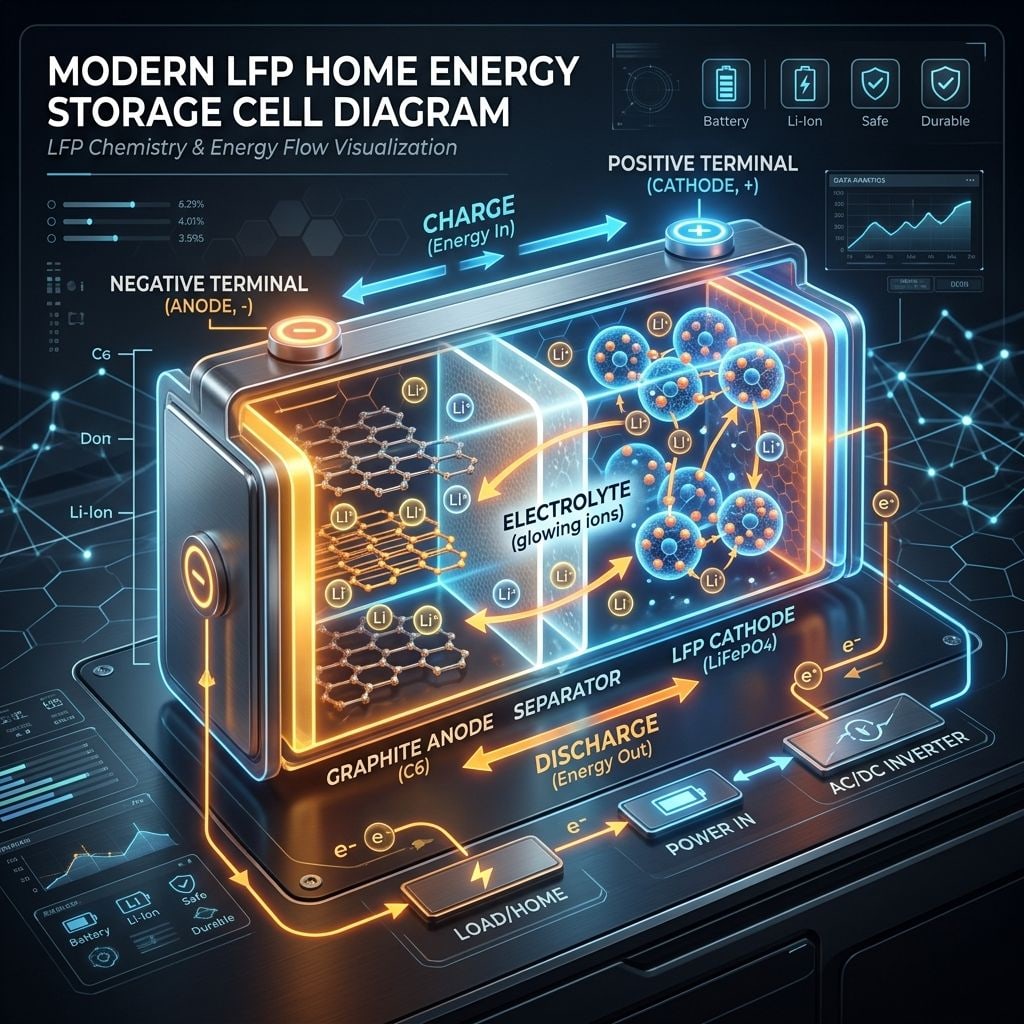
Selecting the right internal cell chemistry is the single most fundamental decision when planning a residential energy storage system. The internal chemical formulation dictates your battery's operational lifespan, daily depth-of-discharge (DoD) tolerance, thermal runaway safety limits, weight, footprint, and long-term levelized cost of storage (LCOS).
While early residential storage systems heavily relied on Nickel Manganese Cobalt (NMC) formulations derived from electric vehicles, the home energy storage market has experienced an industry-wide transition toward Lithium Iron Phosphate (LiFePO4 / LFP). Premium top-tier systems like the Tesla Powerwall 3, Enphase IQ Battery 5P, FranklinWH aPower, and EG4 WallMount now utilize LFP cells exclusively.
Deep Chemistry Breakdown: LFP vs. NMC vs. Emerging Tech
At the atomic level, battery chemistries differ by their cathode structure and chemical bonds:
• Lithium Iron Phosphate (LFP / LiFePO4): Features a 3D olivine crystal lattice with covalent Phosphorus-Oxygen (P-O) bonds. These ultra-strong chemical bonds prevent oxygen gas liberation even under extreme overcharging or high-temperature abuse.
• Nickel Manganese Cobalt (NMC / LiNiMnCoO2): Uses a layered oxide crystal structure. While providing high volumetric energy density (Wh/L), the metal-oxygen bonds release oxygen gas at elevated temperatures (above 410°F), accelerating combustion during cell breakdown.
• Sodium-Ion (Na-Ion) & Solid-State: Emerging chemistries currently entering pilot stationary storage. Sodium-Ion offers non-flammable low-cost performance, while Solid-State replaces liquid electrolytes with non-combustible ceramic separators.
15-Year Capacity Degradation Math & Performance Retention
All lithium battery chemistries undergo capacity degradation due to solid electrolyte interphase (SEI) growth, electrolyte oxidation, and active lithium loss over time. However, LFP cells degrade at less than half the rate of NMC chemistry under daily solar self-consumption and Time-of-Use (TOU) load shifting.
The table below models realistic usable capacity retention for a nominal 13.5 kWh LFP pack cycled once daily at 100% Depth of Discharge:
Thermal Safety, NFPA 855 Codes, and UL 9540A Standards
Thermal runaway occurs when an internal short circuit or extreme heat causes a cell temperature to rise rapidly, triggering exothermic decomposition. LFP chemistry's high thermal runaway onset threshold (518°F / 270°C) eliminates self-sustaining fire propagation.
Residential energy storage systems must comply with National Fire Protection Association (NFPA 855) standards and Underwriters Laboratories (UL) testing:
Frequently Asked Questions About Battery Chemistry
• Can I mix LFP and NMC batteries in the same home system? No. LFP and NMC cells have different nominal cell voltages (3.2V for LFP vs. 3.6V for NMC) and distinct charge profiles. Attempting to mix chemistries on a shared DC bus will damage the Battery Management System.
• Does cold weather ruin LFP home batteries? No, but cold temperatures restrict charging. The internal BMS automatically halts charging at temperatures below 32°F (0°C) to prevent lithium metal plating on the anode. Premium outdoor LFP systems include built-in internal thermal heating pads.
• Why are Tesla Powerwall 3 and Enphase 5P using LFP instead of NMC? Both manufacturers transitioned to LFP to eliminate cobalt supply chain bottlenecks, deliver a 10-year/100% DoD warranty, and achieve superior thermal safety compliance under stringent residential fire codes.
• What happens to an LFP battery after 15 years? An LFP battery does not suddenly stop working at Year 15. It simply retains roughly 70–72% of its original nameplate capacity. It remains fully functional for stationary backup power, self-consumption, and TOU rate arbitrage for many additional years.
Explore Chemistry Deep Dives & Spoke Guides
For detailed calculations on degradation curves and fire clearance standards, read our supporting guides:
• LFP Battery Lifespan: Degradation & 15-Year Expectancy
• Thermal Runaway in Home Batteries: Safety Ratings & Installation Clearance Rules
Written by
Maaz
Admin
5+ years of aggregated research and design experience in home battery and off-grid solar planning.