Tesla Powerwall 3 vs. Enphase IQ Battery 5P: Head-to-Head Comparison
Compare Tesla Powerwall 3 vs. Enphase IQ Battery 5P. Learn about usable capacities, microinverter architectures, peak surge power, and warranty durations.
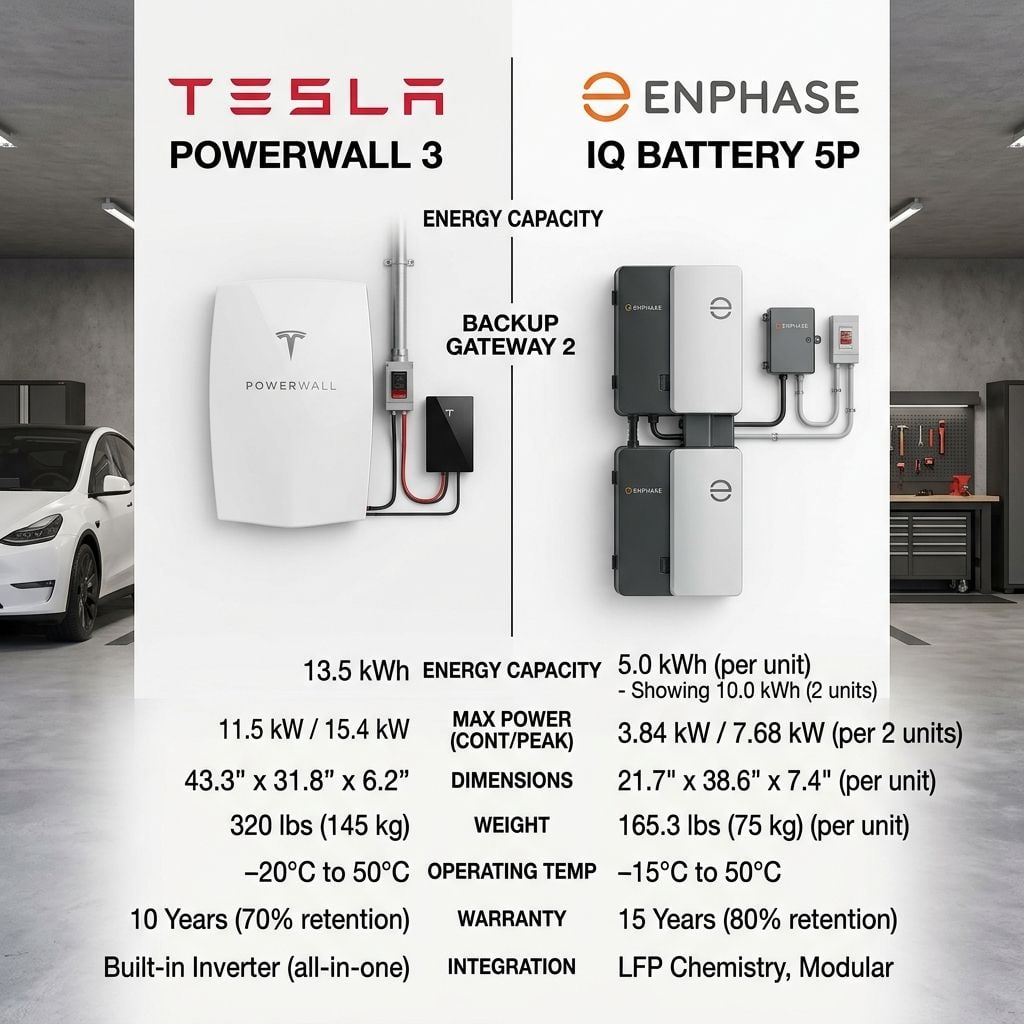
For new solar installations or backing up high-power whole-home loads, the Tesla Powerwall 3 is the clear winner due to its integrated hybrid inverter, high efficiency, and larger base capacity. However, for retrofitting storage onto an existing solar array or prioritizing long-term modular reliability with a 15-year warranty, the Enphase IQ Battery 5P is superior.
Decision support
Comparison breakdown
| Criterion | Tesla Powerwall 3 | Enphase IQ Battery 5P | Best fit |
|---|---|---|---|
| Usable Capacity | 13.5 kWh | 5.0 kWh (Modular) | Tesla Powerwall 3Tesla offers 2.7x more base capacity per module than Enphase. |
| Coupling Style | DC-Coupled | AC-Coupled | tieTesla's DC design is more efficient; Enphase's AC design is easier to retrofit. |
| Continuous Power | 11.5 kW | 3.84 kW (per unit) | Tesla Powerwall 3Tesla provides significantly higher continuous power output. |
| Peak Surge Power | 11.5 kW (LRA) | 7.68 kW (per unit) | tieBoth support heavy starting currents, but Enphase scales surge with added units. |
| Warranty Length | 10 Years | 15 Years | Enphase IQ Battery 5PEnphase offers an industry-leading 15-year warranty. |
| Chemistry | LFP (Cobalt-free) | LFP (Cobalt-free) | tieBoth use ultra-safe, long-lasting Lithium Iron Phosphate chemistry. |
When choosing a home energy storage system, the final decision almost always boils down to a matchup between two industry giants: Tesla and Enphase. Both manufacturers make premium, ultra-safe Lithium Iron Phosphate (LFP) systems, but their technical designs are fundamentally different.
Tesla's Powerwall 3 represents a centralized, DC-coupled approach with a powerful integrated hybrid inverter and high peak power. Enphase's IQ Battery 5P utilizes a decentralized, AC-coupled microinverter architecture that focuses on modular reliability, scaling capacity in 5 kWh increments. Here is our head-to-head comparison of Tesla Powerwall 3 vs. Enphase IQ Battery 5P.
Hardware Architectures: Centralized vs. Modular
The core technical difference between these two batteries is how they handle electrical inversion:
Tesla Powerwall 3: Features a single, central hybrid inverter housed inside the battery chassis. This inverter manages both your solar panels (up to 20 kW DC solar input) and the battery cells. By utilizing a centralized hybrid design, the Powerwall 3 simplifies hardware layouts and keeps system pricing lower.
Enphase IQ Battery 5P: Houses six separate IQ8D-BAT microinverters inside each 5 kWh battery enclosure. This decentralized layout eliminates single points of failure. If one microinverter fails, the battery continues to operate at reduced capacity rather than shutting down completely.
Key Comparison Criteria
1. Sizing and Capacity Scaling
How you scale your home backup depends on modular sizing restrictions:
Tesla Powerwall 3: Offers a base capacity of 13.5 kWh. To scale your system, you can stack DC-coupled expansion cabinets (each adding 13.5 kWh) up to a maximum of 40.5 kWh per gateway controller. This is highly cost-effective for large whole-home projects but limits modular flexibility for smaller homes.
Enphase IQ Battery 5P: Offers modular 5.0 kWh building blocks. Homeowners can install 1, 2, or 3 units to match their exact backup needs (e.g. 5, 10, or 15 kWh), adjusting capacity in precise increments.
2. Power Output and Startup Surge Capacity
Starting heavy inductive motor loads (such as central AC units or deep well pumps) requires high startup surge current (LRA):
Tesla Powerwall 3: Delivers an exceptional 11.5 kW of continuous power output and can start heavy loads without requiring soft starters, making it the premier choice for large HVAC systems.
Enphase IQ Battery 5P: A single 5P unit delivers 3.84 kW of continuous power, but features a high peak surge output of 7.68 kW for 3 seconds. Multiple units must be installed in parallel to start heavy appliances safely.
3. Efficiency and Installation Retrofits
DC-coupled systems (Powerwall 3) route solar power directly into LFP storage, achieving a high round-trip efficiency of 90%. However, because they require a central hybrid inverter, retrofitting them onto an existing solar array is complex. Conversely, AC-coupled systems (Enphase 5P) lose about 4% more energy in conversion loops but connect directly to your main electrical panel, making retrofits quick and inexpensive.
Warranty Coverage and Lifespan (10 vs. 15 Years)
Warranty terms are a primary differentiator for long-term investments:
Tesla: Guarantees a standard 10-year warranty, promising the Powerwall 3 will retain at least 70% of its usable 13.5 kWh capacity at the end of the term.
Enphase: Offers an industry-leading 15-year warranty on the IQ Battery 5P, reflecting their confidence in microinverter longevity. Like Tesla, Enphase guarantees 70% capacity retention at the end of 15 years.
Warranty Duration Comparison
Enphase offers an exceptional 15-year warranty on the IQ Battery 5P, reflecting their confidence in modular microinverter reliability. Tesla offers a standard 10-year warranty on the Powerwall 3. Both warranties guarantee 70% capacity retention at the end of their respective terms.
Tesla Powerwall 3 vs. Enphase IQ 5P Comparison Matrix
The table below compares the critical specifications of Tesla and Enphase residential battery storage systems:
Tesla vs. Enphase Head-to-Head Specification Matrix
| Usable Capacity (Per Battery Unit) | Tesla: 13.5 kWh | Enphase: 5.0 kWh (Modular) |
| Coupling Style & Inversion Architecture | Tesla: DC-Coupled (Central Hybrid) | Enphase: AC-Coupled (Microinverters) |
| Continuous Power Output (Single Unit) | Tesla: 11.5 kW | Enphase: 3.84 kW |
| Warranty Duration (70% capacity guarantee) | Tesla: 10-Year Warranty | Enphase: 15-Year Warranty |
Final Verdict: Which Battery Should You Choose?
The choice between Tesla and Enphase depends on your system scale and solar timeline. If you are installing a new solar array or require whole-home backup for heavy air conditioning loads, the Tesla Powerwall 3 is the clear winner due to its integrated hybrid inverter and high continuous output. However, if you are adding storage to an existing solar system, prefer modular 5 kWh increments, or prioritize a 15-year warranty, the Enphase IQ Battery 5P represents the superior long-term investment. To estimate your payback period and evaluate local incentives, use our interactive ROI calculator tool below:
Evidence
Sources and methodology
Article FAQ
Common questions
Can I mix a Tesla Powerwall battery with Enphase microinverters?
Yes. In an AC-coupled configuration, a Tesla Powerwall battery can be retrofitted onto a roof utilizing Enphase microinverters. The microinverters convert solar power to AC, and the Powerwall's internal inverter converts it back to DC for storage. However, they will run on separate mobile apps.
Which battery is cheaper to install?
Per kilowatt-hour, the Tesla Powerwall 3 is significantly cheaper because of its centralized design. A single Powerwall 3 ($11,959 MSRP / 13.5 kWh) offers roughly $885 per kWh. An Enphase 5P ($4,000 MSRP / 5.0 kWh) costs roughly $800 per kWh for hardware, but requires more gateways and wiring when scaling, making it more expensive for larger projects.
Which battery is better for off-grid operations?
The Tesla Powerwall 3 is generally superior for off-grid use because of its larger continuous output (11.5 kW) and high peak surge capacity, which allows it to handle the starting current of heavy well pumps and air conditioners without overload trip risks.

Written by
Battery Planning Editorial Team
The official editorial and research team for Battery Planning, providing expert battery sizing guides, specifications audits, and cost estimation planners.