Tesla Powerwall 3 vs. FranklinWH aPower: Head-to-Head Comparison
Compare Tesla Powerwall 3 vs. FranklinWH aPower. Learn about usable capacities, continuous outputs, standby generator ports, and smart load shedding.
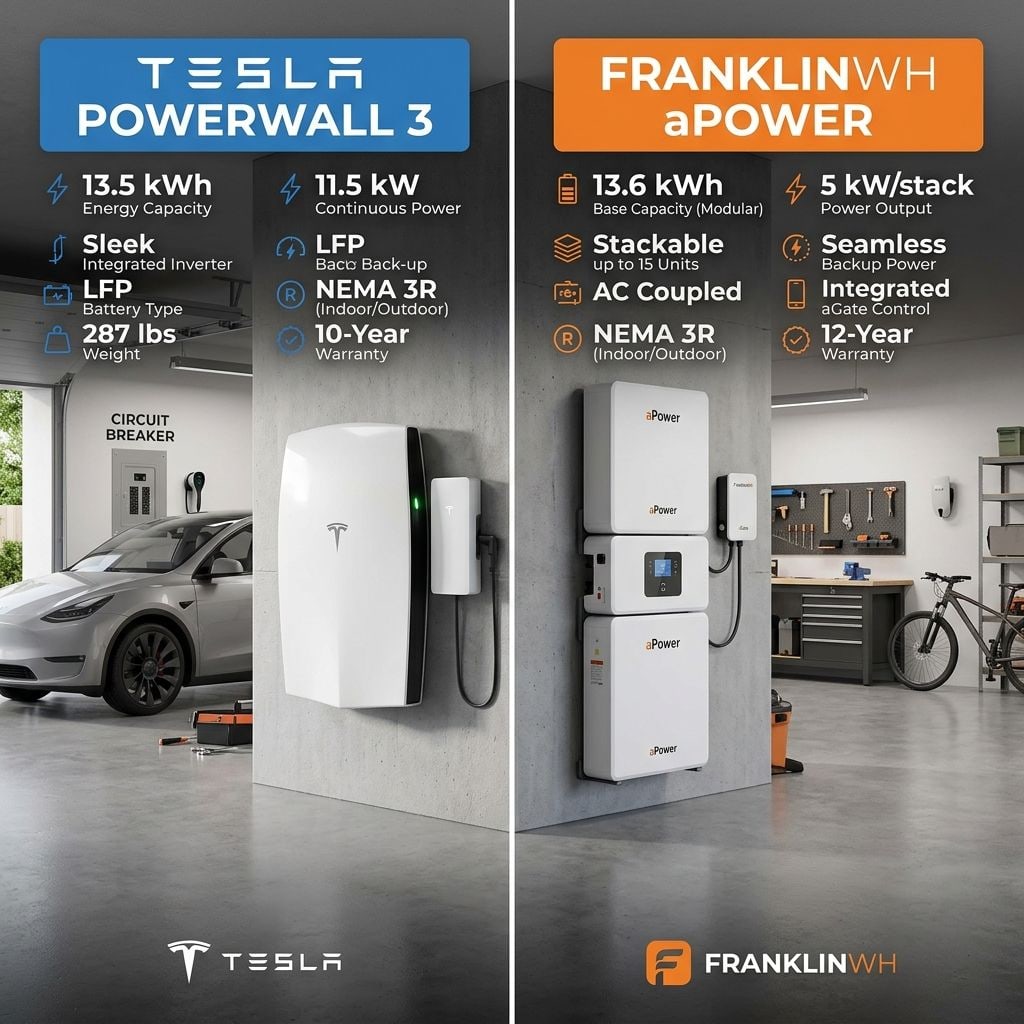
For new solar installations or maximum power output, the Tesla Powerwall 3 is the clear winner due to its integrated hybrid inverter and 11.5 kW continuous output. However, for homes with standby generators or those requiring native smart load management without buying a separate smart panel, the FranklinWH aPower system is superior.
Decision support
Comparison breakdown
| Criterion | Tesla Powerwall 3 | FranklinWH aPower | Best fit |
|---|---|---|---|
| Usable Capacity | 13.5 kWh | 13.6 kWh | tieBoth offer virtually identical storage capacities per battery unit. |
| Inverter Type | Integrated DC Hybrid | AC-Coupled (Separate) | Tesla Powerwall 3Tesla's integrated hybrid design yields higher conversion efficiency. |
| Continuous Power | 11.5 kW | 5.0 kW | Tesla Powerwall 3Tesla delivers significantly higher continuous power output per unit. |
| Generator Integration | Limited (No native port) | Native (aGate port) | FranklinWH aPowerFranklinWH can natively control and recharge from a standby generator. |
| Smart Load Shedding | Requires separate hardware | Built-in (4 circuits) | FranklinWH aPowerFranklinWH natively controls heavy loads directly inside the app. |
| Warranty Length | 10 Years | 10 Years | tieBoth offer standard 10-year warranties with a 70% capacity guarantee. |
When preparing your home for extended utility outages, selecting a battery system requires evaluating both raw capacity and smart power routing. The matchup between the Tesla Powerwall 3 and the FranklinWH aPower represents a head-to-head comparison between two of the most capable whole-home backup products on the market.
Tesla's Powerwall 3 represents an integrated, solar-first DC-coupled design featuring high continuous output and simplified inverter wiring. The FranklinWH aPower system is an AC-coupled setup focused on grid-resiliency, smart circuit controls, and native standby generator integration. Here is our head-to-head comparison of Tesla Powerwall 3 vs. FranklinWH aPower.
System Philosophies: Integrated Solar vs. Advanced Power Management
These systems utilize fundamentally different engineering approaches to manage residential energy:
Tesla Powerwall 3: Centralizes the system's brain and solar inversion. It is designed to act as both your solar inverter and your battery, optimizing conversion efficiency. This DC-coupled approach is ideal for new solar customers looking to minimize hardware box count.
FranklinWH aPower: Separates energy storage from energy control. The system pairs the aPower battery units (which use separate microinverters) with the aGate smart controller. The aGate acts as a complete home energy management panel, natives generator hookups, and controls smart circuits.
Head-to-Head Comparison Criteria
1. Usable Storage Capacity and Scaling
Both systems offer substantial base capacity, but scale to different limits:
Tesla Powerwall 3: Houses 13.5 kWh of LFP storage. You can stack DC expansion cabinets to reach 27 or 40.5 kWh per gateway controller, which is sufficient for most suburban estates.
FranklinWH aPower: Houses 13.6 kWh of LFP storage per battery module. The aGate can coordinate up to 15 aPower modules in parallel, yielding a massive 204 kWh of total energy storage—sufficient to power commercial estates or off-grid ranches indefinitely.
2. Continuous and Peak Power Output
How many heavy appliances you can run simultaneously during a blackout is limited by output ratings:
Tesla Powerwall 3: Delivers an industry-leading 11.5 kW of continuous power output from a single unit, which is sufficient to start and run a central air conditioner and other essentials easily.
FranklinWH aPower: A single aPower unit delivers 5.0 kW of continuous output. However, it features a high transient peak surge rating of 10.0 kW for 10 seconds. Stacking multiple aPower units increases continuous output, with two units delivering 10.0 kW.
3. Standby Generator Integration
During prolonged multi-day blackouts, solar panels may fail to recharge your battery due to heavy storm clouds. This is where standby generators are critical:
FranklinWH: The aGate contains a native, pre-wired generator input port. It can automatically start your generator when the battery runs low, run the home on generator power, and use excess generator output to recharge the battery. This is the gold standard for generator integration.
Tesla Powerwall 3: Does not feature a native generator port. Generator integration requires installing separate manual transfer switches and prevents the generator from recharging the battery, limiting coordination during extended outages.
Generator Integration Champion
FranklinWH is the clear winner for properties with existing standby generators. The aGate features a dedicated, pre-wired generator input port that allows the battery and generator to work together seamlessly to power the home and recharge the battery during extended multi-day outages.
4. Smart Load Shedding and Circuit Management
To prevent your battery from draining in a few hours, you must control heavy loads:
FranklinWH: The aGate features built-in smart circuit relays. Homeowners can designate up to four heavy load circuits (e.g. EV charger, pool pump, water heater) inside the app. When a blackout occurs, the aGate automatically sheds these loads to preserve battery runtime, and lets you toggle them back on manually.
Tesla: Does not include smart relays. Homeowners must buy a separate smart sub-panel (like SPAN) or wire a physical critical loads sub-panel to isolate heavy appliances.
Warranty Terms and Lifespan
Both manufacturers back their LFP chemistry with standard industry warranties:
Tesla Powerwall 3: Covered by a 10-year warranty guaranteeing at least 70% capacity retention at the end of the term.
FranklinWH aPower: Covered by a 10-year warranty guaranteeing at least 70% capacity retention at the end of the term, backed by an impressive 43 Megawatt-hours (MWh) throughput clause.
Tesla Powerwall 3 vs. FranklinWH aPower Comparison Matrix
The table below compares the critical specifications of Tesla and FranklinWH residential storage systems:
Tesla vs. FranklinWH Head-to-Head Specification Matrix
| Usable Capacity (Per Battery Unit) | Tesla: 13.5 kWh | FranklinWH: 13.6 kWh |
| Inverter Type & System Coupling | Tesla: Integrated DC Hybrid | FranklinWH: AC-coupled (separate inverter) |
| Continuous Power Output (Single Unit) | Tesla: 11.5 kW | FranklinWH: 5.0 kW |
| Standby Generator Port (aGate integration) | Tesla: No native support | FranklinWH: Yes, native pre-wired port |
| Smart Circuit Load Shedding relays | Tesla: Requires separate hardware | FranklinWH: Yes, 4 circuits built-in |
Final Verdict: Which Battery Fits Your Outage Needs?
The choice between Tesla and FranklinWH comes down to your backup fuel sources and load management goals. If you are starting fresh with solar, want maximum efficiency, and have no generator, the Tesla Powerwall 3 represents a highly efficient and cost-effective system. However, if you already have a standby generator, need to back up a large estate, or want native smart circuit management without buying a separate smart panel, the FranklinWH aPower system is the superior whole-home backup investment. To estimate your payback period and evaluate local incentives, use our interactive ROI calculator tool below:
Evidence
Sources and methodology
Article FAQ
Common questions
Can I add a generator to my Tesla Powerwall 3 system later?
Yes, but they will not coordinate automatically. The generator must connect via a separate manual or automatic transfer switch. During a blackout, the generator can run your home, but it cannot communicate with the Powerwall 3 or recharge the battery cells, which limits coordination compared to FranklinWH.
Does the FranklinWH system support DC-coupled solar?
No. The FranklinWH aPower is an AC-coupled storage system. It is designed to work alongside existing solar inverters (such as Enphase microinverters or SMA string inverters) by connecting directly to your home's AC breaker panel, making it highly compatible for retrofits.
Which system is better for off-grid operations?
FranklinWH is generally preferred for off-grid locations because it allows you to connect a standby generator natively to charge the battery bank during extended cloudy weeks, and supports scaling up to 204 kWh of capacity.

Written by
Battery Planning Editorial Team
The official editorial and research team for Battery Planning, providing expert battery sizing guides, specifications audits, and cost estimation planners.