How to Size a Battery Backup for a Home Well Pump
Learn how to size a home battery backup system for a water well pump. Understand 240V split-phase power, starting surge (LRA), and battery sizing steps.
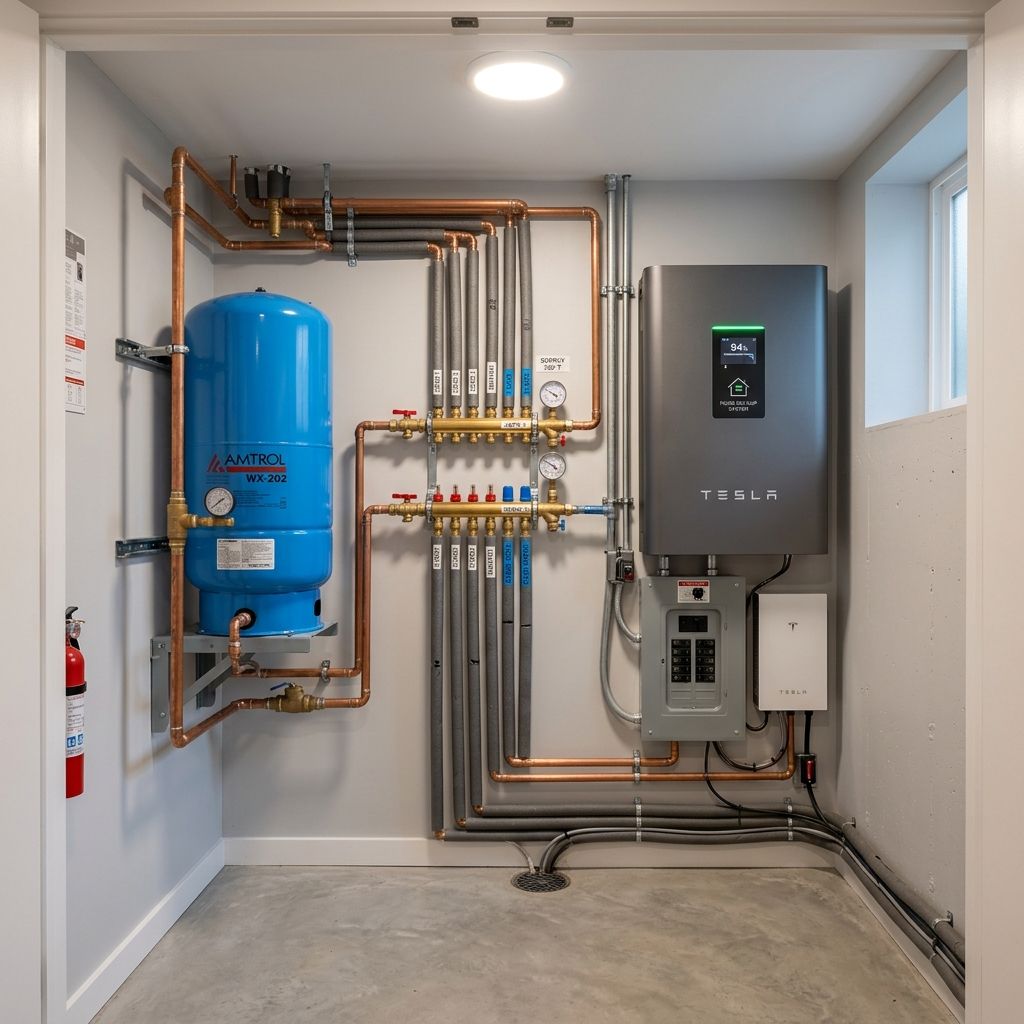
For millions of homeowners living in rural and suburban communities, water security is entirely dependent on a private water well. When a severe storm knocks out the local electrical grid, losing power doesn't just mean dark rooms—it means losing running water, toilets, and showers.
To secure their water supply during blackouts, homeowners are increasingly incorporating their deep well pumps into solar-plus-storage planning. However, deep well pumps are notoriously difficult to back up. They are inductive motor loads that demand specialized voltage configurations and draw massive startup current spikes.
In short: To run a standard well pump on a battery backup system, you must meet two criteria: a 240V split-phase power supply and a battery inverter that supports the pump's high starting surge. Sizing a system without checking these specs will cause your backup power to shut down immediately when you turn on a faucet. This guide walks you through the sizing process step-by-step.
The Core Challenge: Voltage and Phase Requirements
Most electrical appliances in your home (lights, televisions, chargers) run on standard 120V electricity. However, heavy-duty electrical motors—including the submersible pumps submerged hundreds of feet down well shafts—almost always run on 240V split-phase power.
Standard residential battery backups (such as a single Enphase IQ 5P or portable battery station) output 120V power by default. A single 120V battery cannot run a 240V well pump. To deliver the necessary split-phase power, you must utilize one of three installation methods:
Linked Inverters: Wire two compatible 120V batteries in series/parallel configurations so they combine to output 240V split-phase power.
Split-Phase Smart Gateways: Install a smart transfer gateway (such as the Tesla Gateway 3, FranklinWH aGate, or Enphase System Controller 3) that splits power across both busbars of your electrical panel.
Autotransformers: Use a specialized step-up autotransformer to convert 120V battery output into 240V split-phase power.
Split-Phase 240V Required
Before buying a battery, locate your well pump's double-pole circuit breaker in your electrical panel. If the breaker is double-wide and marked 240V, a single 120V battery backup cannot run the pump unless linked in a split-phase network.
Calculating Well Pump Running vs. Starting Power
When sizing your battery capacity, you must distinguish between running load and starting surge:
Running Watts: The continuous power the pump draws while actively moving water. While 1 Horsepower (HP) is mathematically equivalent to 746 Watts, electric motors are not 100% efficient. In practice, a 1 HP submersible pump draws approximately 1,500 Watts (1.5 kW) continuously while running.
Starting Surge (LRA): For a split second when the pump motor first starts spinning, it draws 3 to 5 times its running load to overcome motor friction. For a 1 HP pump, this startup surge can reach 6,000 to 7,500 Watts (6.5 to 7.5 kW). If your battery inverter's surge rating is lower than this startup spike, the safety breakers will trip instantly.
Battery Sizing Scenarios based on Pump Horsepower (HP)
The size of the battery system you need is determined by your well pump's Horsepower (HP) rating. Let's look at the standard sizing requirements:
1/2 HP Submersible Well Pumps
A typical 1/2 HP well pump draws about 800 to 950 Watts running and requires a startup surge of approximately 3,500 Watts. Because this surge is moderate, a single top-tier home battery (like a Tesla Powerwall 3 or FranklinWH aPower) can comfortably start and run this pump, provided it is wired through a split-phase gateway.
3/4 HP Submersible Well Pumps
A 3/4 HP pump draws roughly 1,200 Watts continuously and demands a startup surge of 4,800 to 5,500 Watts. A single battery with strong peak surge capacity can start this pump, but running other household appliances at the same time could overload the system.
1 HP (and larger) Submersible Well Pumps
A heavy-duty 1 HP well pump draws 1,500 to 1,800 Watts running and demands a massive startup surge of 6,500 to 8,000 Watts. Submersible pumps larger than 1 HP require a minimum of two home batteries stacked in parallel to guarantee successful startup without tripping the system's inverters.
Well Pump Sizing Matrix Guide
Well Pump Power Requirements & Battery Sizing
| 1/2 HP Pump (950W running / 3,500W surge) | Requires 1 Battery Unit (via 240V split-phase gateway) |
| 3/4 HP Pump (1,200W running / 5,000W surge) | Requires 1-2 Battery Units (based on continuous surge rating) |
| 1 HP Pump (1,600W running / 7,200W surge) | Requires 2 Stacked Battery Units in parallel |
Top Solutions to Run a Well Pump on Battery Backup
If you want to optimize your water security setup, consider these three installation upgrades:
Increase Your Pressure Tank Size: Your water pressure tank stores pressurized water so your pump doesn't have to start every time you wash your hands. Replacing a standard 20-gallon tank with a 40- or 80-gallon pressure tank allows you to draw water multiple times before the pump motor cycles, reducing starting surge frequency and saving battery energy.
Install a Variable Frequency Drive (VFD): Standard well pumps are single-speed (on/off). A VFD converts the pump into a variable-speed unit, ramping the motor speed up gradually over several seconds. This eliminates the starting surge current spike completely, allowing even small batteries to start a large pump.
Sizing Recommendations & Next Steps
Sizing a backup system for well water security requires calculating both 240V split-phase compatibility and motor surge currents. While a 1/2 HP pump can run on a single robust battery, larger pumps demand a stacked dual-battery configuration. To audit your water pump's continuous electricity needs, use our interactive sizing calculator below:
Evidence
Sources and methodology
Article FAQ
Common questions
Can I run a 240V well pump on a portable power station?
Yes, but only if the portable power station outputs split-phase 240V power (such as the EcoFlow Delta Pro Ultra or Anker Solix F3800). Standard 120V portable power stations cannot power a 240V pump.
How long will a 10 kWh battery run a well pump?
Because well pumps run intermittently (cycling for a few minutes at a time rather than running continuously), they consume very little total energy. A 10 kWh battery can easily provide running water for a household for 5 to 7 days, provided heavy continuous loads are avoided.
Does a variable-speed (VFD) well pump require a soft starter?
No. Variable-frequency drives naturally ramp up motor speeds gradually, eliminating the LRA current spike completely. They do not need a soft starter accessory.

Written by
Battery Planning Editorial Team
The official editorial and research team for Battery Planning, providing expert battery sizing guides, specifications audits, and cost estimation planners.