How Long Will a 10 kWh Battery Last? (Typical Outage Runtimes)
Discover how long a 10 kWh home battery backup system will last during a blackout. Compare runtimes for basic essentials, critical loads, and central AC systems.
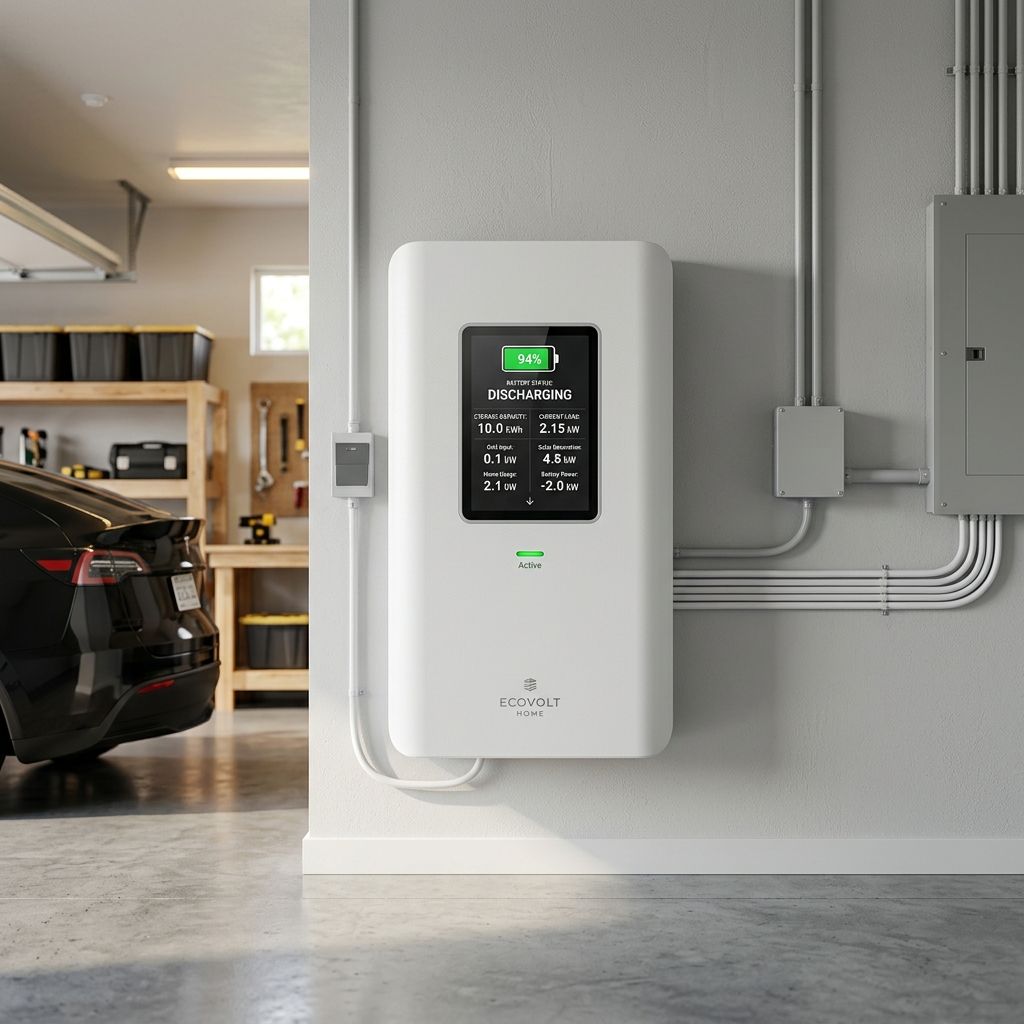
When homeowners begin shopping for backup storage, the 10 kWh battery is the most common size they encounter. Popular systems like the Tesla Powerwall 3 (13.5 kWh usable), the FranklinWH aPower (13.6 kWh usable), and stacks of modular batteries like the Enphase IQ Battery 5P typically hover around this capacity range.
But when a storm knocks out the power grid, what does 10 kilowatt-hours actually translate to in your home? How long will your lights stay on, and will your food stay cold?
In short: A 10 kWh battery will last anywhere from 2 to 36 hours during a blackout. The exact runtime is not a fixed number; it is entirely dependent on the specific electrical appliances you choose to run and how much power they draw. If you only power basic essentials like your refrigerator, internet router, and a few lights, a 10 kWh battery can easily last over 24 hours. However, if you attempt to run heating elements or central air conditioning, it can drain in under 3 hours. Understanding the mathematical constraints and preparing for specific backup scenarios is the only way to avoid a sudden blackout shutdown.
The Runtime Math: Usable Capacity and Inverter Loss
Before tallying your appliances, you must understand a critical rule of home energy storage: A 10 kWh battery does not actually give you 10 kWh of usable electricity.
When sizing a home battery, we must factor in two efficiency losses:
Depth of Discharge (DoD) Limits: To protect the internal cells and extend the battery's lifespan, modern systems do not allow you to discharge them to 0%. The percentage of energy you can safely use is called the Depth of Discharge. While top-tier Lithium Iron Phosphate (LFP) batteries support a high 90% to 95% DoD, a nominal 10 kWh battery with a 90% DoD limit only offers 9.0 kWh of usable capacity.
Inverter Conversion Loss: Batteries store power in Direct Current (DC), but your home runs on Alternating Current (AC). Converting DC to AC through the system's inverter generates heat, wasting about 5% to 10% of the energy. With a typical 90% inverter efficiency, your 9.0 kWh of usable capacity is reduced to 8.1 kWh of actual AC power delivered to your appliances.
To calculate your runtime, use this basic formula: Runtime (Hours) = Usable AC Capacity (8.1 kWh) / Continuous Electrical Load (kW).
Nominal vs. Usable Capacity
Always verify the 'usable capacity' spec sheet rating before making a purchase. Sizing your runtime using the nominal (advertised) capacity rather than the usable capacity will result in a 10% to 15% runtime deficit during a real emergency.
Scenario 1: Basic Essentials Only (Runtime: 24 to 36 Hours)
For most homeowners, the primary goal of emergency backup is simple: keep the food from spoiling, keep the internet active, and keep the phones charged.
Under this minimal backup scenario, you isolate only low-power, critical devices onto your critical loads panel. Let’s look at the electrical audit for this configuration:
Refrigerator (Modern): Draws approximately 150 watts (0.15 kW) when the compressor is running. Because compressors cycle on and off, it runs about 30% of the time, consuming roughly 1.2 to 1.8 kWh over a 24-hour period.
Wi-Fi Router & Modem: Draws a continuous 15 watts (0.015 kW). Over 24 hours, this draws 0.36 kWh.
LED Light Bulbs (x5): Running five 10-watt LED bulbs for 6 hours in the evening draws 50 watts (0.05 kW) for a total consumption of 0.3 kWh.
Mobile Phone Chargers (x2): Periodic charging draws about 10 watts (0.01 kW) per device, consuming roughly 0.1 kWh daily.
The Runtime Result: Your average continuous draw under this essential load profile is approximately 75 to 100 watts (0.075 to 0.10 kW). Applying our runtime formula: Runtime = 8.1 kWh / 0.10 kW = 81 Hours (Theoretical max limit). In practice, because the refrigerator compressor draws a higher startup surge and runs dynamically, a single 10 kWh battery will comfortably sustain this basic essentials profile for 24 to 36 hours on a single charge. If your system is paired with solar panels, a typical sunny day will easily recharge the battery, allowing you to sustain this minimal load indefinitely.
Scenario 2: Standard Critical Loads (Runtime: 10 to 18 Hours)
If you want to maintain a higher level of comfort—adding water supply, hot meals, and medical devices—your continuous power draw increases.
Under this standard critical load profile, you add a few moderate-draw appliances:
Well Pump (1 HP): Draws 1.5 kW while actively pumping water. Well pumps cycle on demand rather than running continuously. If it runs for a combined 30 minutes throughout the day, it consumes 0.75 kWh.
Microwave (1000W): Used for a total of 15 minutes to heat food, drawing 1.2 kW continuous. Total daily consumption is 0.3 kWh.
Medical CPAP Machine: Essential for sleep apnea, drawing a continuous 60 watts (0.06 kW). Running for 8 hours of sleep consumes 0.48 kWh.
Laptops & Monitors (x2): Working from home draws about 150 watts (0.15 kW) combined. Running for 8 hours consumes 1.2 kWh.
The Runtime Result: Your average continuous load under this profile is approximately 450 to 600 watts (0.45 to 0.60 kW). Runtime = 8.1 kWh / 0.50 kW = 16.2 Hours. This configuration will keep your home fully functional for a standard 12-to-18 hour outage. Sizing your system to match these load limits allows you to comfortably survive overnight blockouts without running out of capacity.
Scenario 3: Whole-Home / High-Power Backup (Runtime: 2 to 4 Hours)
A single 10 kWh battery cannot run a modern household normally. Attempting to power heavy cooling, heating, or laundry appliances will exhaust the cells almost instantly.
Electric Water Heaters: Draw 4.5 kW continuous while heating water. Running for just 1 hour consumes 4.5 kWh, draining over 55% of your battery's usable energy.
Central Air Conditioners: A standard 3-ton central AC unit draws 3.5 kW continuous. Running it for 2 hours consumes 7.0 kWh, bringing a 10 kWh battery to the brink of shutdown.
The Runtime Result: Under a heavy whole-home load profile where continuous consumption averages 2.5 kW to 4.0 kW, a single 10 kWh battery will shut down in 2 to 4 hours. Furthermore, standard 10 kWh batteries (excluding the Tesla Powerwall 3) often have continuous output limits capped at 5.0 kW, meaning turning on a water heater and a microwave simultaneously will trip the internal circuit breakers immediately.
Crucial Factors That Impact Battery Runtime
Understanding environmental and installation parameters prevents real-world performance drops:
Ambient Temperature: Home batteries are sensitive to temperature extremes. Operating a battery in freezing temperatures (below 32°F) or high heat (above 110°F) reduces cell efficiency and triggers built-in safety throttles, lowering your usable runtime by up to 20%.
Coupling Efficiency: DC-coupled systems route solar power directly to the battery, losing only 2% to 4% in conversion. AC-coupled systems require three separate conversions (DC solar -> AC home -> DC battery -> AC home), losing 8% to 12% in the process.
Runtime Comparison Matrix
10 kWh Battery Runtime Scenarios Summary
| Scenario 1: Basic Essentials (Lights, Wi-Fi, Refrigerator) | 24 to 36 Hours (Continuous Draw: 100W) |
| Scenario 2: Critical Loads (Essentials + Well Pump, CPAP, Microwave) | 10 to 18 Hours (Continuous Draw: 500W) |
| Scenario 3: Heavy Whole-Home (Essentials + Central AC, Water Heater) | 2 to 4 Hours (Continuous Draw: 3,000W) |
How to Calculate Your Custom Battery Runtime
To find your precise runtime, compile a spreadsheet of every appliance you plan to power. Note their running wattages, calculate their cycle runtimes, and sum their total daily kilowatt-hours. Then use the formula: Runtime = 8.1 kWh / Summed load (kW). To make this calculation simple, you can use our interactive sizing calculator tool below:
Conclusion & Sizing Recommendations
A 10 kWh battery is the perfect entry-level choice for basic emergency security. If your primary goal is keeping the lights on, the food cold, and the communication active, a single unit will comfortably carry you through a standard multi-hour outage. However, if your home relies on heavy well pumps or HVAC systems, you should consider upgrading to a 20 kWh configuration or linking multiple units in parallel to avoid overload shutdowns.
Evidence
Sources and methodology
Article FAQ
Common questions
Can a 10 kWh battery run a central air conditioner?
Only for a very brief period (typically less than 2 hours) and only if the battery's inverter supports the high starting surge of the AC motor. To back up an AC system, it is recommended to install a soft starter or stack multiple battery modules.
How many solar panels does it take to charge a 10 kWh battery?
A standard 10 kWh battery requires approximately 11 to 12 kWh of solar generation to charge from empty (accounting for conversion losses). An average 4 kW solar array (about 10 panels) will fully charge the battery in 3 to 4 hours of direct sunlight.
Will a 10 kWh battery run a microwave?
Yes. A standard microwave draws 1.0 kW to 1.5 kW continuous. A 10 kWh battery can easily support this load, but because microwaves run for very short periods, their impact on your overall capacity is minimal.

Written by
Battery Planning Editorial Team
The official editorial and research team for Battery Planning, providing expert battery sizing guides, specifications audits, and cost estimation planners.