How to Audit and Calculate Home Energy Consumption: Complete Guide
Learn how to calculate your home energy consumption, audit appliance wattages, eliminate vampire loads, and model daily kWh for solar and battery planning.
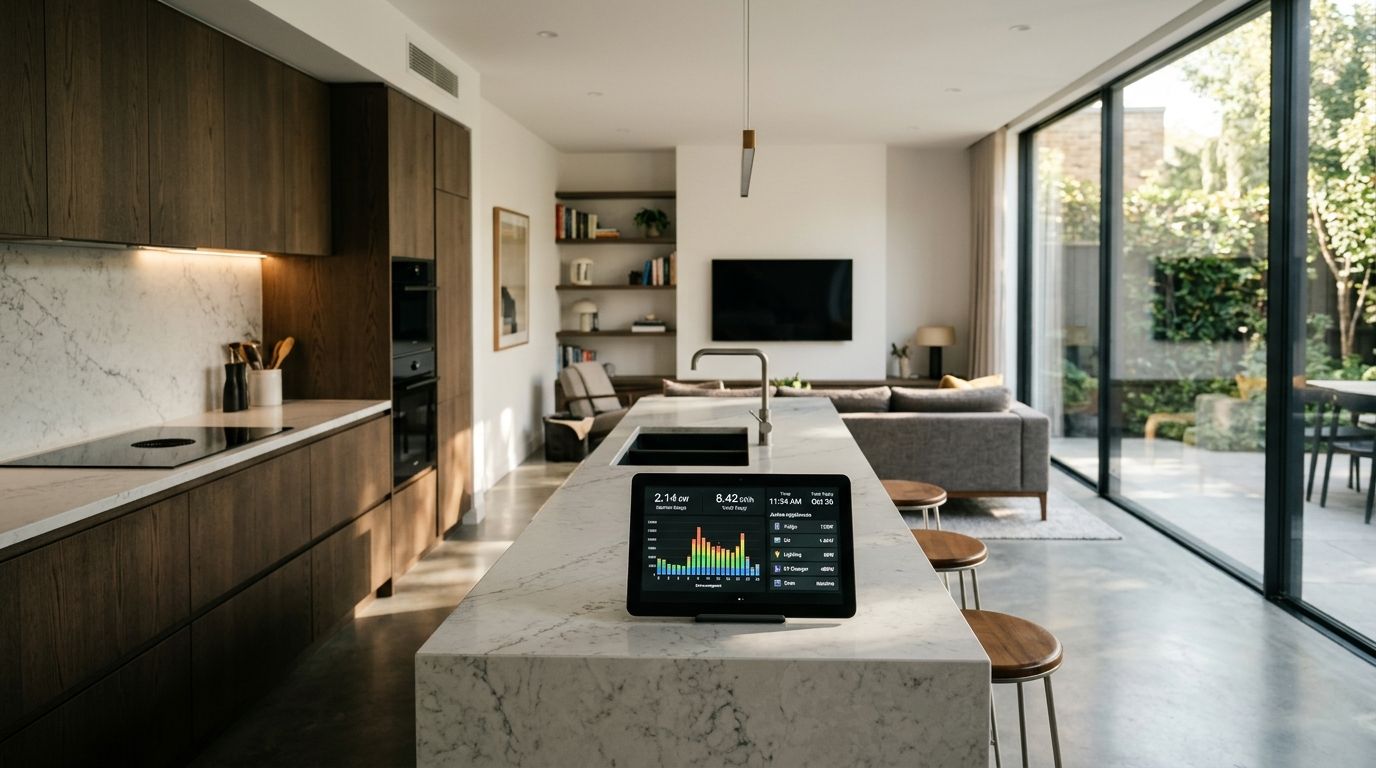
Before you can size a home battery backup system, determine how many solar panels your roof requires, or accurately forecast electric utility bill savings, you must understand your household energy consumption. Guessing your electricity demands based purely on home square footage or a single monthly electric bill leads to costly mistakes—either overspending thousands on excess hardware or installing a system that runs dry during an emergency.
An accurate home electrical audit reveals exactly where kilowatt-hours are consumed, distinguishes continuous running loads from motor startup power spikes, and exposes invisible waste. This comprehensive guide details how to read utility meter intervals, audit individual appliance wattages, eliminate vampire power draw, and model your daily energy profile using our interactive Energy Consumption Calculator.
Executive Summary: The Core Principles of Energy Auditing
When preparing for solar panels or battery storage, home energy management rests on four technical foundations:
1. Electricity Volume vs. Flow Speed: Total daily consumption is measured in kilowatt-hours (kWh); the rate at which power is drawn at any single moment is measured in kilowatts (kW).
2. Base Load vs. Intermittent Load: Refrigerators, network routers, and HVAC blowers run continuously or cycle around the clock, establishing your 24-hour baseline. Cooking ranges, microwaves, and power tools create brief, high-power spikes.
3. Start-Up Surge Multipliers: Motorized inductive appliances (air conditioners, well pumps, heat pumps) require 2x to 5x their normal running wattage for several seconds to start.
4. Rate Schedule Alignment: Under modern Time-of-Use (TOU) tariffs, *when* you consume electricity matters just as much as *how much* you consume.
Understanding Electrical Units: Kilowatts (kW) vs. Kilowatt-Hours (kWh)
The most frequent mistake homeowners make when evaluating backup power is confusing power output (kW) with energy capacity (kWh). Keeping this distinction clear is critical:
• Watts (W) and Kilowatts (kW) — Power (Speed): A kilowatt is 1,000 watts. This represents the rate at which electricity flows at an exact instant. Think of kilowatts as the speedometer of your car, or the flow rate of water through a garden hose. A 1,500W space heater draws 1.5 kW of instantaneous power when turned on.
• Kilowatt-Hours (kWh) — Energy (Volume): A kilowatt-hour represents volume over time. If that 1.5 kW space heater runs continuously for 4 hours, it consumes 6.0 kWh of energy (1.5 kW × 4 hours = 6.0 kWh). Think of kilowatt-hours as the size of your vehicle's fuel tank, or gallons of water in a bucket.
When sizing equipment, your battery's continuous inverter rating (in kW) determines how many appliances can run simultaneously without tripping the system. Meanwhile, your battery's total capacity (in kWh) determines how many hours or days those appliances will run before the battery is depleted. For a detailed breakdown of capacity math, see our How to Size a Home Battery Backup System Guide.
Comprehensive Appliance Wattage Breakdown
Household energy use is rarely distributed evenly. In typical single-family homes, heating, cooling, and water heating account for over 50% of total electrical consumption, followed by major motor appliances and plug loads:
Motor Inrush and Soft Starter Advisory
Notice the extreme starting surge on central air conditioners and well pumps. Inductive electric motors draw high inrush currents for 100 to 300 milliseconds when starting against compressor pressure. Without a soft starter kit, a central AC can demand up to 16,000W of instant surge power, instantly shutting down standard 5 kW or 10 kW battery inverters even if the battery has plenty of stored kWh.
How to Read Your Electric Utility Bill Like an Energy Engineer
Before purchasing auditing hardware, examine your monthly electric utility bills. Most modern utility customer portals provide detailed hourly interval data logged by digital smart meters:
• Total Monthly kWh & Daily Averages: Look at your billing history across a full 12-month calendar year. American households consume an average of roughly 900 kWh per month (30 kWh/day), but seasonal heating and cooling spikes can swing monthly use between 600 kWh in spring and 2,000+ kWh in mid-summer.
• Time-of-Use (TOU) Tiered Rates: Review your rate tariff breakdown. Utilities increasingly divide days into On-Peak, Off-Peak, and Super-Off-Peak periods. If on-peak power costs 55¢/kWh while off-peak is 22¢/kWh, moving discretionary consumption away from peak hours creates dramatic financial savings even without changing overall kWh volume.
• Net Metering Export Credits: If you already have solar panels, examine your net generation exports. Under modern net billing structures (such as California's NEM 3.0), utilities pay as little as 5¢ to 8¢/kWh for daytime solar exports, making Solar Self-Consumption via battery storage essential.
Eliminating Vampire Draw & Phantom Loads
One of the easiest ways to reduce required battery size and cut electric bills is identifying Phantom Loads (Vampire Draw). Phantom load refers to the continuous electric power consumed by electronic devices while they are switched off or in standby mode.
Cable TV set-top boxes, gaming consoles, smart speakers, microwave clocks, laptop chargers, and smart TVs constantly draw between 2 and 40 watts each. Across a modern home, cumulative phantom loads often total 150 to 300 watts around the clock.
While 200 watts seems small, multiplying 200W by 24 hours equals 4.8 kWh every single day, or roughly 144 kWh per month. That represents nearly 15% of an average home's entire electric consumption! During a power outage, a 4.8 kWh phantom load consumes more than one-third of a standard 13.5 kWh battery pack without running a single essential appliance. Utilizing smart power strips and turning off unused standby circuits directly extends your emergency backup duration.
Step-by-Step Home Energy Audit Formula
To audit any electrical device manually, locate the UL certification label on the back or underside of the appliance. Look for the power rating stated in Watts (W) or Amps (A) and Volts (V):
If only Amps and Volts are listed, calculate wattage using the standard electrical power formula:
$$\text{Power (Watts)} = \text{Current (Amps)} \times \text{Voltage (Volts)}$$
Once you have the wattage, calculate daily kilowatt-hour energy consumption:
$$\text{Daily Energy (kWh)} = \frac{\text{Power (Watts)} \times \text{Hours Used Per Day}}{1,000}$$
For example, if an auxiliary refrigerator runs its 150W compressor for 8 cumulative hours per day:
$$\text{Daily Energy} = \frac{150 \times 8}{1,000} = 1.20 \text{ kWh/day}$$
Multiplying this daily figure by 30 gives a monthly consumption of 36.0 kWh/month.
Time-of-Use Peak Shaving and Load Shifting Strategies
Energy management is not just about using less energy; it is about smart timing through Load Shifting. By scheduling heavy, flexible energy loads outside of peak utility pricing windows, homeowners reduce electricity bills substantially without sacrificing comfort:
• Electric Vehicle Charging: Schedule your EV to charge exclusively after midnight during super-off-peak hours when grid electricity rates are lowest.
• Pre-Cooling and Pre-Heating: Cool your home down 2 to 3 degrees below your target temperature at 2 PM using cheaper mid-day solar or off-peak power, then raise the thermostat between 4 PM and 9 PM to coast through peak hours without running the AC compressor.
• Heat Pump Water Heating Timers: Set modern hybrid water heaters to heat water during daytime hours when rooftop solar is generating surplus electricity.
Pros
- Smart Electrical Panels (Span / Emporia): Measures real-time electrical draw across every individual breaker circuit.
- Automatic cloud logging of starting surges, phantom loads, and hourly trends.
- Allows dynamic remote load-shedding during grid power outages from your smartphone.
- Provides 100% comprehensive data across 240V heavy appliances (HVAC, pumps, water heaters).
Cons
- Plug-In Power Meters (Kill-A-Watt): Inexpensive ($25–$35) and requires zero electrical installation or permitting.
- Limited to standard 120V plug-in wall outlets (cannot measure 240V hardwired HVAC or water heaters).
- Requires manually moving the meter from appliance to appliance over several days to gather data.
Connecting Your Energy Audit to Solar & Battery Planning
Once your energy audit establishes your average daily consumption and essential critical load wattage, you have the exact numbers required to design a balanced, cost-effective clean energy system:
• Critical Load Backup Design: If an emergency outage occurs, prioritizing your essential loads (refrigerator, well pump, Wi-Fi, lights = ~6 kWh/day) allows a single 10 kWh to 13.5 kWh battery to provide days of continuous power.
• Whole-Home Backup Requirements: If you choose to back up everything including central air conditioning and laundry (~30 kWh/day), you will require 2 or 3 stacked battery units (26 kWh to 40 kWh total capacity) and soft-starter accessories.
For complete pricing breakdowns, tax credits, and installation guidelines, continue your planning with our core authority guides:
• Appliance Wattage Guide: How Many Watts Do Home Appliances Use? — Complete reference table covering running and surge watts for 50+ household devices.
• How to Size a Home Battery Backup System — Step-by-step capacity sizing formulas, Depth of Discharge (DoD), and inverter selection.
• Home Battery Backup Costs: The Complete Pricing Guide — Equipment prices, installation labor, and soft costs.
• Home Battery Incentives, Tax Credits & Rebates Guide — How to claim the 30% federal clean energy tax credit on IRS Form 5695.
Evidence
Sources and methodology
Article FAQ
Common questions
How many kilowatt-hours (kWh) does an average home consume per day?
In the United States, an average residential home consumes approximately 28 to 30 kilowatt-hours (kWh) of electricity per day (around 850 to 900 kWh per month). However, homes with electric heat pumps, central air conditioning, or electric vehicle chargers often consume 40 to 60+ kWh daily.
What is the difference between running watts and starting surge watts?
Running watts represent the continuous electrical power an appliance needs to operate normally. Starting surge watts represent the brief burst of extra electrical current (2x to 5x higher) required by motorized compressors and pumps to start from a standstill.
How much electricity is typically wasted by phantom / vampire loads?
According to the U.S. Department of Energy, standby power drawn by electronics while switched off accounts for 10% to 20% of residential electric consumption, wasting an average of 100 to 300 watts around the clock (2.4 to 7.2 kWh per day).
Can an energy audit help reduce the required size of a battery backup system?
Yes. Identifying and eliminating vampire loads and separating non-essential heavy appliances allows homeowners to install a smaller, less expensive battery (such as a 10 kWh unit instead of stacking multiple packs), saving $8,000 to $12,000 in upfront hardware costs.
Written by
Battery Planning Editorial Team
The official editorial and research team for Battery Planning, providing expert battery sizing guides, specifications audits, and cost estimation planners.