Home Battery Backup Power: The Complete Emergency Outage Guide
Master guide to emergency home battery backup power. Learn about essential load panels, automatic transfer switches, motor surge currents, appliance wattages, and multi-day outage runtimes.
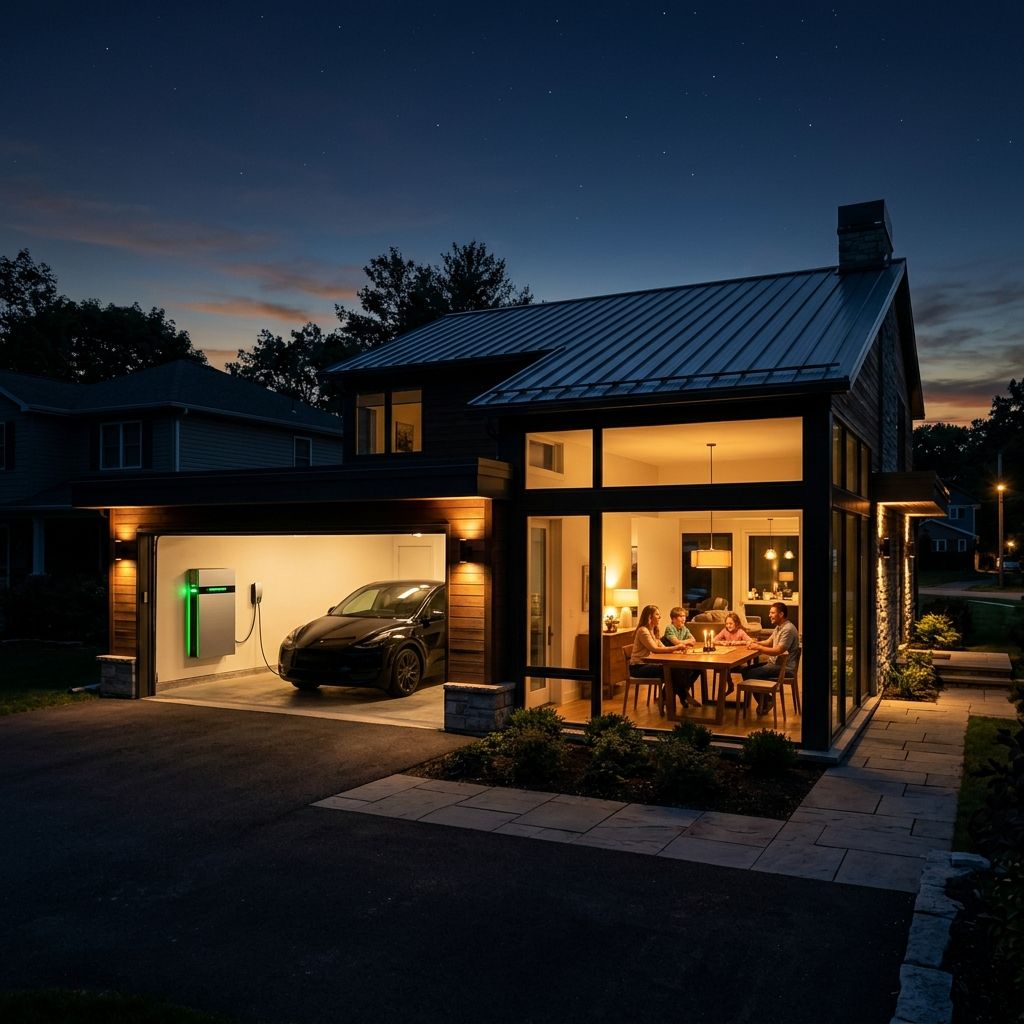
When severe weather, wildfire safety cutoffs, or aging grid infrastructure knock out electrical power, having a home battery backup system turns an emergency into a manageable inconvenience. However, configuring a residential energy storage system for blackouts requires strategic design rather than simple guesswork.
A home battery backup system does more than just store solar energy; it acts as a personal microgrid. When utility power drops, the system instantly isolates your home from the electrical grid, energizing your critical appliances in less than 16 milliseconds.
In this master guide, we break down the engineering principles of home backup power: partial vs. whole-home backup configurations, how Automatic Transfer Switches (ATS) work, managing motor startup surge currents, and strategies to maintain continuous power during multi-day grid blackouts.
Key Outage Design Rule
Sizing a backup power system requires auditing both total energy volume (kilowatt-hours, kWh) to determine outage duration and peak continuous power (kilowatts, kW) to ensure your battery inverter can start high-surge motor loads without tripping safety breakers.
System Architectures: Partial Home vs. Whole-Home Backup
The single biggest decision in home battery design is selecting between an Essential Loads (Partial Home) backup configuration and a Whole-Home backup layout.
Option 1: Essential Loads (Partial Home) Backup
In an essential loads configuration, your installer mounts a secondary electrical panel—known as a critical loads sub-panel—next to your main breaker box. Only selected essential circuits are re-routed into this sub-panel.
Typical circuits connected to a critical loads panel include: refrigerators and freezers, Wi-Fi routers and home networking, LED lighting circuits, basement sump pumps, medical CPAP equipment, gas furnace blowers, and selected kitchen outlets.
By isolating these vital loads and excluding power-hungry appliances (such as electric clothes dryers, central air conditioners, EV chargers, and hot tubs), a standard 10–13.5 kWh battery bank can easily extend your backup runtime from 24 hours to over 3 continuous days.
Option 2: Whole-Home Backup
In a whole-home configuration, the battery gateway is installed between your electric meter and your main 200-Amp electrical panel. Every circuit in the house receives battery backup when a blackout strikes.
While whole-home backup delivers maximum comfort—allowing you to turn on any light or appliance without thinking—it requires significantly higher continuous inverter power (11.5 kW to 15 kW) and a larger battery bank (20 kWh to 40 kWh). Running central air conditioning or electric water heating without solar input can drain a single 13.5 kWh battery in as little as 3 to 5 hours.
Smart Electrical Panels (SPAN & Lumin)
Modern smart load-management panels (like SPAN or Lumin) allow you to turn whole-home panels into dynamic backup systems. During a grid blackout, the smart panel automatically sheds non-essential heavy circuits, giving you software control over load prioritization directly from your smartphone.
How Microgrid Islanding and Automatic Transfer Switches Work
When utility grid power fails, your home battery backup system must perform a process called microgrid islanding:
1. Grid Disconnection: An Automatic Transfer Switch (ATS) or Microgrid Interconnection Device (MID) detects grid failure within milliseconds and mechanically opens its main contacts. This isolates your home's wiring from the grid, preventing electrical backfeeding into utility power lines (protecting utility line workers during emergency repairs).
2. Inverter Energization: The battery inverter creates an independent 120V/240V split-phase AC voltage waveform, re-energizing your home's backup circuits so quickly that digital clocks, desktop computers, and Wi-Fi routers usually remain running uninterrupted.
3. Microgrid Frequency Control (FSR): If your home features rooftop solar panels, the battery inverter uses Frequency Watt derating (raising AC frequency from 60.0 Hz to 61.0–62.5 Hz) to curtail or shut down solar production when the battery reaches 100% charge, preventing battery overcharging.
4. Seamless Grid Resynchronization: When utility power returns for a sustained safety window (typically 5 minutes), the ATS synchronizes frequency and phase angle with the grid before smoothly reconnecting your home and returning the battery to daily solar self-consumption mode.
Safety Standard UL 1741 SA/SB
All grid-interactive home battery inverters must comply with UL 1741 SA/SB standards. This ensures instant anti-islanding protection when grid power drops, preventing dangerous voltage backfeed.
Appliance Power Consumption and Surge Reference Table
To size your emergency backup system correctly, consult the typical continuous wattages and startup surge requirements of common household appliances below:
Comprehensive Residential Outage Load Power Reference
| Refrigerator / Freezer (Modern) | 150W Running | 800W Surge | 1.5 kWh Daily |
| Wi-Fi Router & Modem | 20W Running | 20W Surge | 0.48 kWh Daily |
| LED Lighting Circuits (x5 Rooms) | 60W Running | 60W Surge | 0.36 kWh Daily (6h) |
| Sump Pump (1/2 HP Submersible) | 1,050W Running | 2,800W Surge | 0.8 kWh Daily (Storm) |
| Deep Well Water Pump (1 HP) | 1,500W Running | 4,500W Surge | 1.5 kWh Daily |
| CPAP Medical Machine (Unheated) | 40W Running | 60W Surge | 0.32 kWh Nightly (8h) |
| Gas Furnace Blower Motor | 600W Running | 1,500W Surge | 4.8 kWh Daily (Winter) |
| Window Air Conditioner (10,000 BTU) | 1,000W Running | 2,900W Surge | 8.0 kWh Daily |
| Central Air Conditioner (3-Ton) | 3,500W Running | 15,000W Surge | 18.0 kWh Daily |
| Electric Water Heater (50 Gal) | 4,500W Running | 4,500W Surge | 4.5 kWh per Cycle |
Estimating Outage Runtimes Across Battery Bank Sizes
How long will your home battery last during an outage? The exact duration depends on your capacity size and power consumption intensity. Below is a comparative runtime matrix across common storage sizes:
Battery Capacity Outage Duration Reference Matrix
| 5.0 kWh Battery (e.g. Enphase 5P) | Minimal Loads: 18–24 Hours | Moderate Loads: 8–12 Hours | Heavy AC Loads: 1–2 Hours |
| 10.0 kWh Battery Bank | Minimal Loads: 36–48 Hours | Moderate Loads: 18–24 Hours | Heavy AC Loads: 2–4 Hours |
| 13.5 kWh Battery (e.g. Powerwall 3) | Minimal Loads: 48–72 Hours | Moderate Loads: 24–36 Hours | Heavy AC Loads: 3–5 Hours |
| 27.0 kWh Battery Bank (Dual Unit) | Minimal Loads: 5+ Days | Moderate Loads: 48–72 Hours | Heavy AC Loads: 8–12 Hours |
| 40.5 kWh Battery Bank (Triple Unit) | Minimal Loads: Indefinite (with Solar) | Moderate Loads: 5+ Days | Heavy AC Loads: 18–24 Hours |
Managing Motor Startup Surge Currents (LRA vs. RLA)
One of the most common causes of battery system shutdowns during outages is motor startup surge current. Inductive electric motors—found in air conditioner compressors, well pumps, sump pumps, and refrigerators—require a high initial current spike to create the magnetic field needed to start rotating.
On equipment nameplates, this is listed as Locked Rotor Amps (LRA), which is often 3 to 6 times higher than the continuous Running Load Amps (RLA).
For example, a 3.5-Ton central AC unit may only draw 15 Amps while running (3,600 Watts), but its Locked Rotor Amps rating might be 78 Amps (18,720 Watts). If your battery inverter cannot supply 18.7 kW of peak surge power, it will trip its over-current safety switch, shutting down your home backup.
Solution: Install an Electronic Soft Starter
Installing an electronic soft starter (such as a Micro-Air EasyStart) on your central AC compressor reduces motor startup surge by 65% to 75%. This drops a 78A surge down to under 25A, allowing a single 11.5 kW battery inverter to start your air conditioner without overload trip risks.
Sustaining Power During Multi-Day Grid Disruptions
During severe multi-day outages caused by hurricanes, ice storms, or grid failures, a battery alone will eventually run out of stored kWh if it cannot be recharged. To maintain continuous power indefinitely, pair your home battery system with rooftop solar panels or a standby generator.
1. Solar-Plus-Storage Pairing: During daylight hours, your rooftop solar panels power your active household loads and route excess clean energy into your battery bank. Once the battery reaches 100% state-of-charge, solar output dynamically adjusts to match house consumption. At night, the battery discharges to keep essential loads running.
2. Generator Integration: In cold or overcast regions where solar production is reduced during winter storms, integrated smart gateways (like FranklinWH aGate or Enphase System Controller) can automatically start a standby fuel generator to recharge the battery bank.
Emergency Outage Preparedness Checklist
- Enable StormWatch / Storm Guard mode in your battery smartphone app to auto-charge to 100% prior to predicted weather events.
- Audit your essential loads sub-panel to confirm critical circuits (refrigerator, router, sump pump, medical devices) are active.
- Test your battery backup system once a year by manually switching off your main utility breaker to verify islanding.
- Ensure rooftop solar panels are clear of heavy snow or debris to maximize daily recharging during extended blackouts.
- Verify your battery reserve margin is set to at least 20% during daily solar self-consumption mode.
Evidence
Sources and methodology
Article FAQ
Common questions
Can a home battery power a central air conditioner during a blackout?
Yes, provided the battery inverter has a high continuous power output (11.5 kW+) or an electronic soft starter is installed on the AC compressor motor. Without a soft starter or large inverter, motor startup surge (LRA) can trip the battery's safety breakers.
How fast does a home battery switch on during a power outage?
Modern LFP battery systems switch on in under 16 milliseconds to 100 milliseconds. This transfer is so rapid that televisions, computers, lights, and Wi-Fi routers operate continuously without resetting.
What is the difference between an essential loads panel and whole-home backup?
An essential loads panel isolates critical circuits (refrigerator, lights, Wi-Fi, pumps) onto a sub-panel, allowing a standard 10–13.5 kWh battery to provide 2 to 3 days of power. Whole-home backup powers your main electrical panel, offering complete comfort but consuming battery energy significantly faster.
Will my solar panels work during a power outage if I have a battery?
Yes! When paired with an islanding-capable battery gateway (Automatic Transfer Switch), your solar panels will continue to generate power, supply your household loads, and recharge the battery bank during daylight hours throughout grid outages.
Written by
Battery Planning Editorial Team
The official editorial and research team for Battery Planning, providing expert battery sizing guides, specifications audits, and cost estimation planners.